
 English
 русский
 Português
 Français


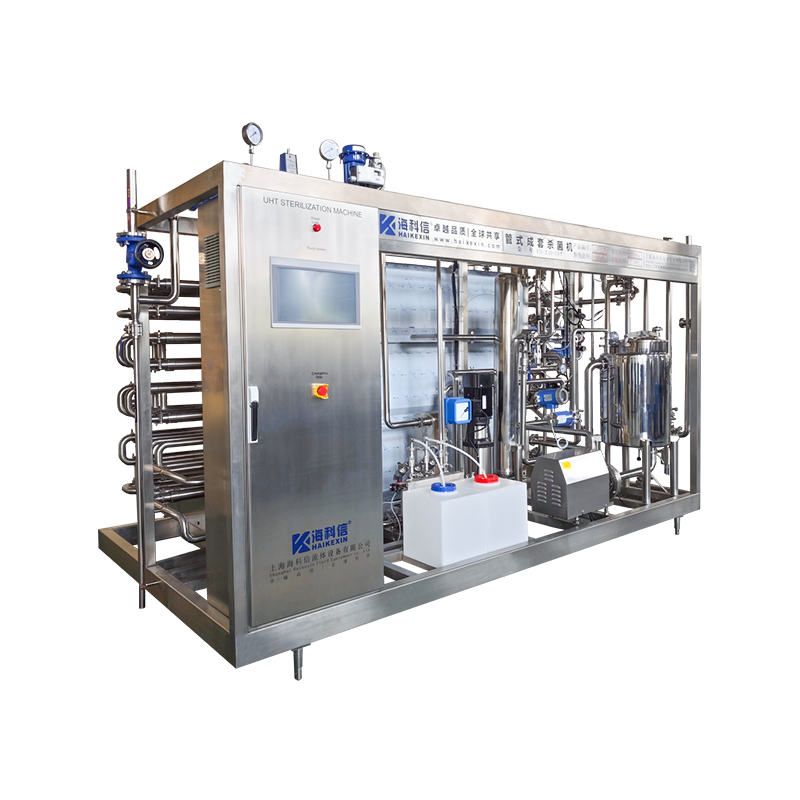
 Read More

Product Category
NEW Category
Contact us
Contact Us
We specialise in the research, development and manufacture of electrical wires and cables.
 +86-21-57560276
UHT Sterilizer vs Pasteurization System: Industrial Processing Differences
Content
- 1 What Separates UHT Sterilization From Pasteurization
- 2 Process Parameters Side by Side
- 3 How the Two Lines Are Built
- 4 Product Quality: What the Extra Heat Costs
- 5 Utilities, Cost Structure and Total Cost of Ownership
- 6 Selection Criteria for a New Line
- 7 Selection Questions That Decide the Specification
The difference between a UHT sterilizer and a pasteurization system comes down to two numbers: 135 °C for 2 to 5 seconds against 72 °C for 15 seconds. Everything else follows from that thermal load: which organisms survive, whether the filler has to be aseptic, whether the product needs a cold chain, and how much of the capital budget lands in refrigeration instead of in the process line. Treating the two as different settings of the same machine is the most expensive specification error in liquid food production.
What Separates UHT Sterilization From Pasteurization
UHT sterilization delivers commercial sterility inside a hermetically sealed package. Pasteurization delivers a pathogen-free product that still depends on refrigeration and a shelf life measured in days rather than months.
Definition. UHT sterilization is a continuous-flow thermal process that heats every particle of product to at least 135 °C for 1 to 5 seconds, cools it inside a closed aseptic system, and fills it into pre-sterilized packaging. Pasteurization is a continuous-flow process that heats product to 72-75 °C for 15-30 seconds, then fills it under hygienic but non-sterile conditions and relies on chilled distribution for safety and quality.
The two processes are validated against different organisms. In milk, HTST pasteurization is benchmarked on a 5-log reduction of Coxiella burnetii, the most heat-resistant non-spore-former of public health concern in raw milk. UHT specifications target heat-resistant spore formers such as Geobacillus stearothermophilus and Bacillus sporothermodurans, and lines are normally designed around a 9-log reduction. That change of target pushes the temperature up by more than 60 °C and collapses the holding time to a few seconds.
135 °C Minimum UHT holding temperature under EU Regulation (EC) No 853/2004
72 °C / 15 s HTST baseline for Grade A milk in the US Pasteurized Milk Ordinance
5 log Coxiella burnetii reduction required to validate pasteurization
9 log Spore reduction used as the usual UHT design basis
Both figures are regulated rather than chosen. EU Regulation (EC) No 853/2004 requires UHT milk to be heated to at least 135 °C for a suitable holding period, and the US Pasteurized Milk Ordinance sets 72 °C for 15 seconds as the HTST baseline for Grade A milk. A line built to 137 °C for 4 seconds is UHT; a line built to 130 °C for 4 seconds is not, whatever the nameplate says.
Process Parameters Side by Side
Most specification debates end once the time-temperature envelope, the packaging obligation and the distribution model are written in one place.
| Parameter | Pasteurization (HTST) | UHT sterilization |
| Holding temperature | 72-75 °C | 135-150 °C |
| Holding time | 15-30 seconds | 2-5 seconds |
| Microbiological target | 5-log reduction of Coxiella burnetii | Commercial sterility, 9-log spore reduction |
| Regulatory reference | US PMO Grade A; EU Reg. 853/2004 | EU Reg. 853/2004 (135 °C minimum); FDA 21 CFR 113 for aseptic low-acid processing |
| Filling environment | Hygienic filler, semi-closed | Aseptic filler with sterile air or steam barrier |
| Typical shelf life | 10-21 days, chilled | 6-9 months, ambient |
| Heat recovery, typical design | 85-92 % on the plate pack | 75-90 % with aseptic regeneration |
| Line preparation | Caustic CIP, typically 70-80 °C | SIP at 130-150 °C before each run |
Holding tube volume is the one dimension that cannot be corrected after fabrication. At 10,000 L/h, a 5-second hold needs roughly 13.9 litres of tube volume; the same flow at 15 seconds needs roughly 41.7 litres. A skid quoted for pasteurization cannot be re-rated to UHT by raising the setpoint, because the holding tube, the regeneration sections and the aseptic boundary would all have to change.
How the Two Lines Are Built
A pasteurization line and a UHT line share a balance tank, a feed pump, a heat exchanger and a holding tube. They diverge at the filler and at everything that protects the filler.
Pasteurization: regeneration and flow diversion
An HTST pasteurizer is built around a multi-section plate heat exchanger. Raw product is preheated by hot product leaving the holding tube, brought to 72-75 °C by hot water, held for 15 seconds, then cooled first against incoming raw product and finally against chilled water at 1-2 °C. Regeneration rates of 85-92 % are normal in modern plate designs, which is why steam and chilled-water demand per litre stays modest. The safety device is the flow diversion valve: if the temperature at the end of the hold falls below setpoint, the valve returns product to the balance tank and nothing reaches the filler.
 Automatic Food Pasteurization System for Heat-Sensitive ProductsIntegrated automatic pasteurization for milk, yogurt, juice and beer, with precise temperature control, heat recovery, CIP cleaning and hygienic construction.View Product →
UHT: the aseptic boundary drives the design
A UHT sterilizer uses either indirect heating (tubular, plate or shell-and-tube) or direct heating (steam injection or infusion). Direct systems add a flash vessel to remove the water condensed into the product; indirect systems avoid that step but expose product to a metal surface at 140 °C and therefore need tighter fouling control. What dominates the project is downstream: aseptic cooling, an aseptic buffer tank, a sterile-air or steam barrier at the filler, and a sterilization-in-place sequence that brings the whole aseptic path to 130-150 °C before production starts.
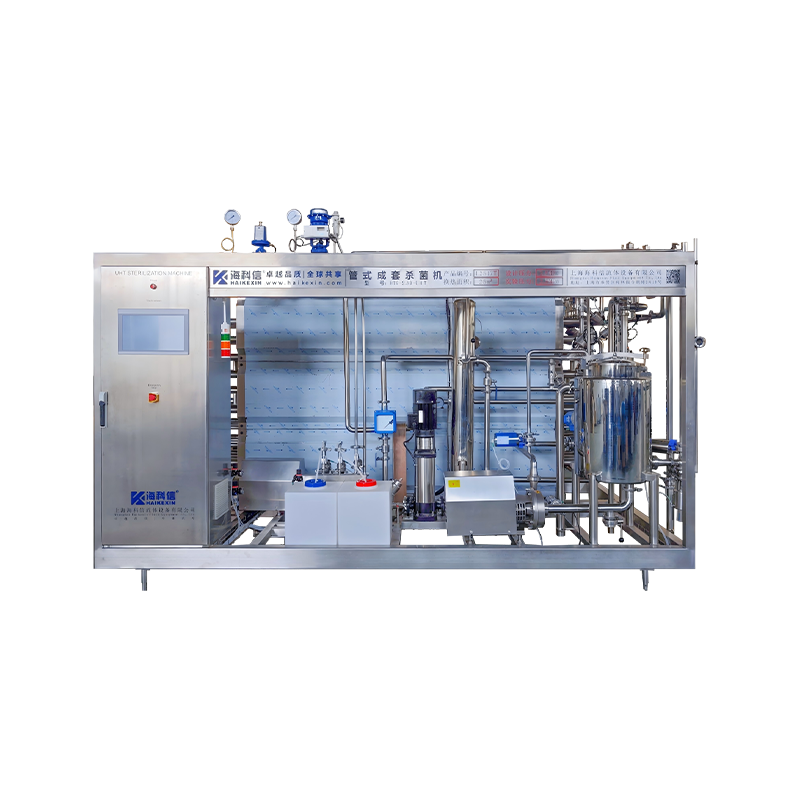
 Automatic UHT Sterilizer for Liquid Food ProcessingCustomizable ultra-high-temperature sterilization for dairy, beverages and heat-sensitive liquids, with automated control, 85%+ heat recovery and CIP cleaning.View Product →
Cleaning, changeover and dead legs
Both lines are cleaned in place, but a UHT line has more surface and more dead legs to validate. A cleaning skid sized for a pasteurizer may not deliver the flow rate, return temperature and coverage that an aseptic line requires, so the CIP specification has to be written together with the process design rather than added afterwards.
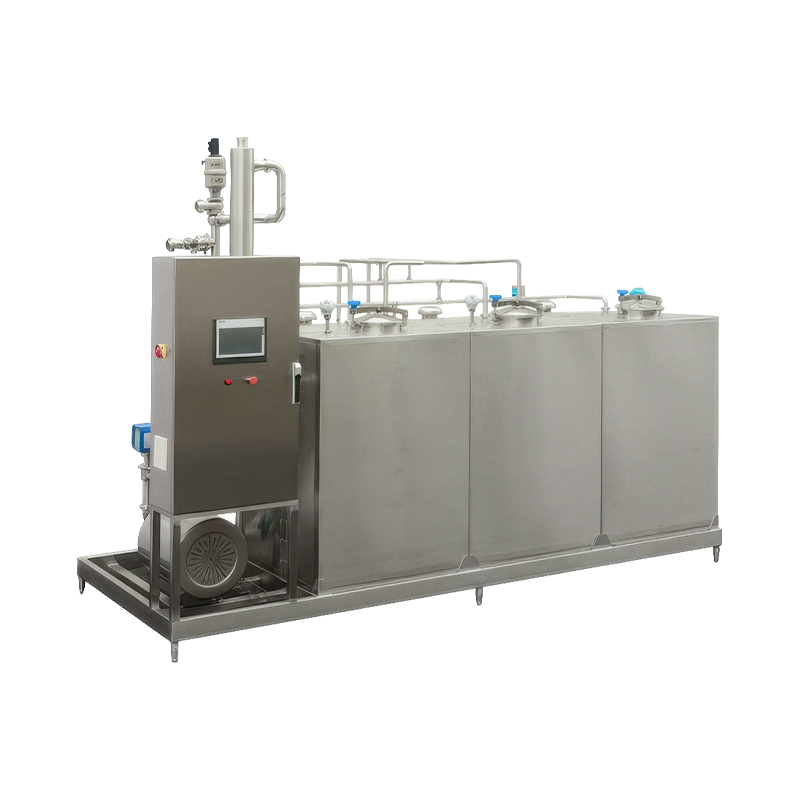
 Food-Grade Clean-in-Place System for Hygienic Processing LinesAutomated CIP solution for pipelines, tanks and production equipment, with PLC control, multi-tank cleaning, data recording and food-grade contact materials.View Product →
Product Quality: What the Extra Heat Costs
UHT buys shelf life with colour, volatile aroma and a measurable share of heat-labile vitamins; pasteurization keeps those attributes and gives up storage time.
Three changes are predictable in UHT milk. Whey proteins denature more completely, which is why UHT milk forms no cream layer and behaves differently from pasteurized milk in rennet trials. Maillard reactions between lactose and lysine produce browning and a cooked note that grows with holding time. Volatile sulfides formed at 140 °C give freshly filled UHT milk a cooked-sulfur character that fades during storage.
Vitamin loss tracks the integrated time-temperature load, not the peak temperature alone. Thiamine and vitamin C are the most heat-labile of the B and C groups, and dairy scientists express the resulting chemical load with the B* index, where B* = 1.0 is the reference value for UHT milk. A process above B* = 1.0 browns more and retains less thiamine at the same bacteriological result.
Direct steam injection and infusion heat and cool faster than indirect tubular systems for equivalent lethality, which is one reason direct systems are chosen where flavour retention matters. The trade-off is a flash vessel, a higher condensate load and more complex aseptic control.
Utilities, Cost Structure and Total Cost of Ownership
UHT moves cost out of the cold chain and into the process line; pasteurization does the reverse.
Pasteurization system
- No aseptic filler, aseptic buffer tank or sterile air package
- Regeneration recovers 85-92 % of the heat in the hot product stream
- Chilled water at 1-2 °C and refrigerated storage are mandatory
- Distribution radius set by a 10-21 day shelf life
- Faster recipe changeover and simpler validation of new products
UHT sterilizer
- Aseptic filler, sterile utilities and validation dominate the budget
- Ambient distribution removes warehouse refrigeration
- An SIP sequence precedes every production run
- The filler is both the throughput limit and the main contamination risk
- Product scope constrained by particulate size and viscosity
When the comparison is done properly, both options are costed over the same horizon and the same volume. Chilled warehousing, refrigerated transport and product loss from expired stock belong on the pasteurization side of the ledger; aseptic packaging material, filler maintenance and line validation belong on the UHT side.
Selection Criteria for a New Line
Six checks separate a sound specification from a nameplate decision.
- Define the distribution model first. Ambient shelf-stable product justifies UHT; a regional chilled brand usually does not.
- Fix the microbiological target with the authority having jurisdiction before the heat and mass balance is drawn.
- Size the holding tube for the maximum flow rate, not the nominal one, and record the resulting hold time in the validation file.
- Treat the aseptic boundary as one package: filler, buffer tank, sterile air, instruments and SIP sequence.
- Confirm CIP and SIP coverage together, including return temperature and dead-leg length.
- Request a heat and mass balance at design flow, with steam, cooling water and electrical demand stated per 1,000 litres.
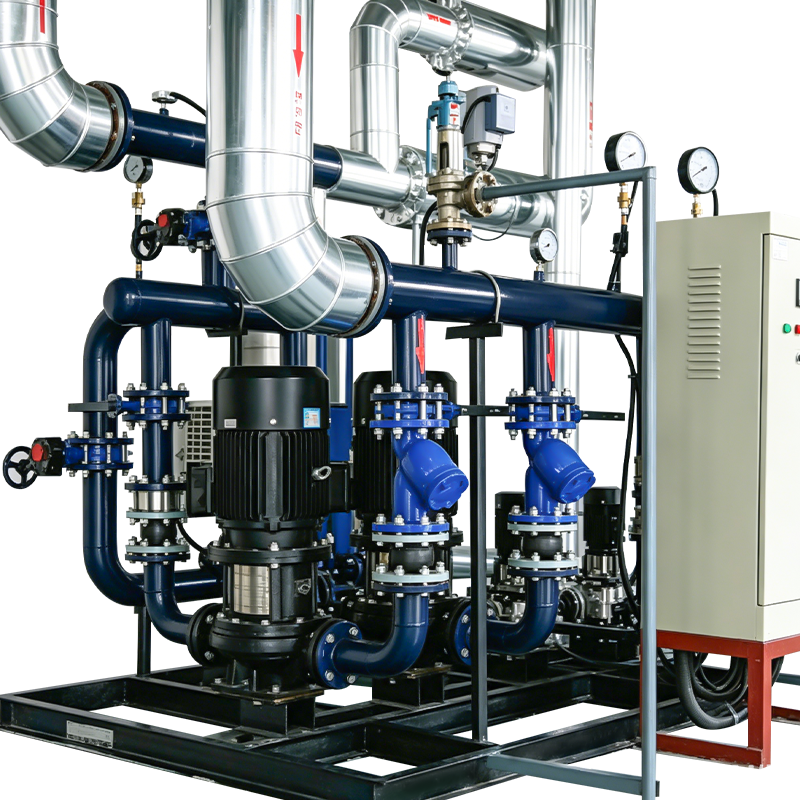
Where several thermal duties sit on one skid, a dairy process skid system can combine preheating, holding, cooling and CIP in a single validated frame, which shortens commissioning compared with field-erected piping.
Selection Questions That Decide the Specification
Can a pasteurization system be converted into a UHT line?
Rarely at acceptable cost. The holding tube, regeneration sections, downstream cooling, aseptic tank and filler all change, and a conversion that keeps the original plate pack cannot reach 135 °C with a compliant hold time. Plan a new aseptic line when the target is ambient shelf life.
Which system suits a chilled dairy or juice brand?
Pasteurization, when the product reaches the consumer within 10-21 days and the route is refrigerated. The lower capital cost, simpler filler and easier changeover outweigh the shorter shelf life for regional distribution.
Does UHT sterilize the packaging as well as the product?
Yes. Product sterility without package sterility fails in the market. Aseptic fillers sterilize packaging surfaces with hydrogen peroxide, peracetic acid or UV, and the whole sterile zone is held under positive pressure with filtered air.
What data should a buyer request before signing?
A heat and mass balance at design flow, steam and cooling water consumption per 1,000 litres, electrical load, sterile air demand, SIP sequence duration, and a written hold-time calculation traceable to the holding tube volume. For dairy applications, the published pasteurization system guide for dairy and beverage lines covers the control logic in more detail.
PREV:Bottom-Mounted Magnetic Mixers: Key Mixing Performance and Hygienic Requirements
NEXT:How to Evaluate UHT Sterilizer Suppliers for Dairy and Beverage Projects
NEXT:How to Evaluate UHT Sterilizer Suppliers for Dairy and Beverage Projects
Interested in cooperation or have questions?
Recommended LINKS
✦
UHT Processing System for Dairy Products
UHT Sterilizer for Fruit Juice
UHT Processing Equipment for Plant Based Milk
Plate Heat Exchanger Pasteurization System
HTST Milk Pasteurization System
Direct Steam Injection UHT System
Indirect Heating UHT Sterilizer
Tubular UHT Sterilization System
Food Processing Skid System
Automatic UHT Sterilizer for Milk
Let'S Work Together Welcome Aboard!
-

haikexin@haikexin.com
+8613391278930
-
 +86-21-57560276
-
 No. 2819, Sihu Road,Fengxian District, Shanghai, China
Join Our Mailing List
Copyright © Shiloc (Shanghai) Industrial Trading Co., Ltd. All Rights Reserved.
Process Systems & Equipment For Food & Biopharma Manufacturers
