
 English
 русский
 Português
 Français


 Read More

Product Category
NEW Category
Contact us
Contact Us
We specialise in the research, development and manufacture of electrical wires and cables.
 +86-21-57560276
How to Evaluate UHT Sterilizer Suppliers for Dairy and Beverage Projects
Content
- 1 Write the Duty Specification Before You Shortlist
- 2 Decide Direct or Indirect Heating Before You Compare Suppliers
- 3 Verify Hold-Tube Residence Time and Back-Pressure Control
- 4 Check Hygiene and CIP as Hard as Thermal Performance
- 5 Tie Payment to the Document Package and the Factory Acceptance Test
- 6 Score Suppliers on Evidence, Not Brochure Capacity
- 7 Fix the Scope Boundary Before You Sign
Three quotations arrive for the same 20,000 L/h UHT line. All three state the same capacity and roughly the same price. Then you compare hold-tube volume, flow-meter accuracy class, the number of CIP return paths and the pressure margin on the aseptic barrier, and the offers stop being comparable. That gap is where dairy and beverage projects lose money, long before the first carton is filled.
This guide covers what to put into the enquiry, what to witness before shipment, and how to weigh the evidence a supplier provides. It is written for the process engineer or project buyer who has to defend the choice to a plant director, not for someone collecting brochures.
Write the Duty Specification Before You Shortlist
A UHT sterilizer should always be quoted against a written duty specification, because two suppliers quoting 20,000 L/h can be describing equipment with different hold-tube volumes, different fouling allowances and different margins on the aseptic cooler.
Fix the following in the RFQ and require every bidder to answer in the same units, on the same page:
- Product family, fat, protein, sugar and total solids, because these set the fouling rate and the heat-transfer behaviour.
- pH and whether the product is classified as a low-acid food, since that decides which thermal-processing rules apply.
- Design flow at the aseptic filler rather than at the feed pump, plus the turndown range the line will actually run.
- Inlet temperature from the balance tank and the target temperature at the filler inlet.
- Particulate size and load, pulp content, and viscosity at process temperature.
- Shelf-life target at ambient temperature and the packaging format.
- Site utilities: culinary steam quality, chilled-water supply temperature, compressed-air dew point and the electrical standard in force.
Vagueness here is expensive. A supplier who is not told the particulate load can quote a plate pack that blinds within four hours of production. A supplier who is not told the turndown range can size the hold tube for design flow and leave the line short of residence time at 60 percent of capacity. Neither failure appears in a comparison of price per litre per hour.
Capacity in litres per hour is the least informative number on a UHT quotation.
Decide Direct or Indirect Heating Before You Compare Suppliers
Direct steam injection or infusion and indirect plate or tubular heating produce measurably different flavour profiles, fouling behaviour and capital cost, so the heating method belongs in your specification rather than in the supplier's discretion.
Direct heating
Steam is injected into or infused through the product, then removed again in a flash cooler. Heating and cooling complete in under a second. Culinary steam quality becomes a food-safety control point.
Indirect heating
Product stays inside plates or tubes while heat crosses a metal wall. Heat-recovery surface is larger, start-up is longer, and fouling on the hot surface sets the maximum run length.
UHT processing, defined
Ultra-high temperature processing heats a liquid product to roughly 135 °C to 150 °C, holds it for about 2 to 10 seconds, then cools and fills it aseptically so the sealed pack stays stable at ambient temperature. The sterilizing effect comes from the time and temperature reached at the coldest point in the hold tube, which is why residence-time verification matters as much as the setpoint.
| Decision point | Direct (injection or infusion) | Indirect (plate or tubular) |
| Heat path | Steam contacts the product and its condensate is absorbed | Product remains sealed; heat crosses a metal wall |
| Ramp speed | Below one second up and down | Slower, limited by surface area and pump pressure |
| Flavour effect | Strips some volatiles and dissolved oxygen | Retains volatiles; cooked notes are more common in milk |
| Fouling | No hot surface in the heater; fouling shifts downstream | Fouling on plates or tube walls caps the run length |
| Particulates and viscosity | Limited by injector or infuser geometry | Plate packs restrict solids; tubular units tolerate more |
| Typical fit | Premium milk and beverages where flavour leads | High-volume commodity milk and long production runs |
Verify Hold-Tube Residence Time and Back-Pressure Control
Residence time is the sterilization parameter buyers most often fail to verify, and it depends on hold-tube volume, true volumetric flow and back-pressure control, not on the temperature setpoint alone.
The arithmetic is simple once the numbers are honest. At a design flow of 20,000 L/h, which is 5.56 L/s, a hold tube with 33.3 L of internal volume delivers 6.0 seconds of holding time. This is an illustrative calculation, not a specification: the real figure must come from a measured internal volume on the approved drawing, corrected for fittings and instrument tees.
135 to 150 °C Typical UHT range
2 to 10 s Hold time window
3 to 4 bar Back pressure above vapour pressure
Ask for five things in the technical offer:
- A hold-tube volume calculation referenced to the as-built isometric drawing.
- The calibration certificate and accuracy class of the flow meter used in that calculation.
- The response time of the temperature sensor and transmitter, because a slow RTD reports a temperature the product has already left behind.
- The back-pressure control philosophy, including behaviour on loss of signal, loss of sterile air or a stuck valve.
- A safety thermal-limit function that is independent of the control loop, following the pattern set for thermal processing systems under US 21 CFR Part 113.
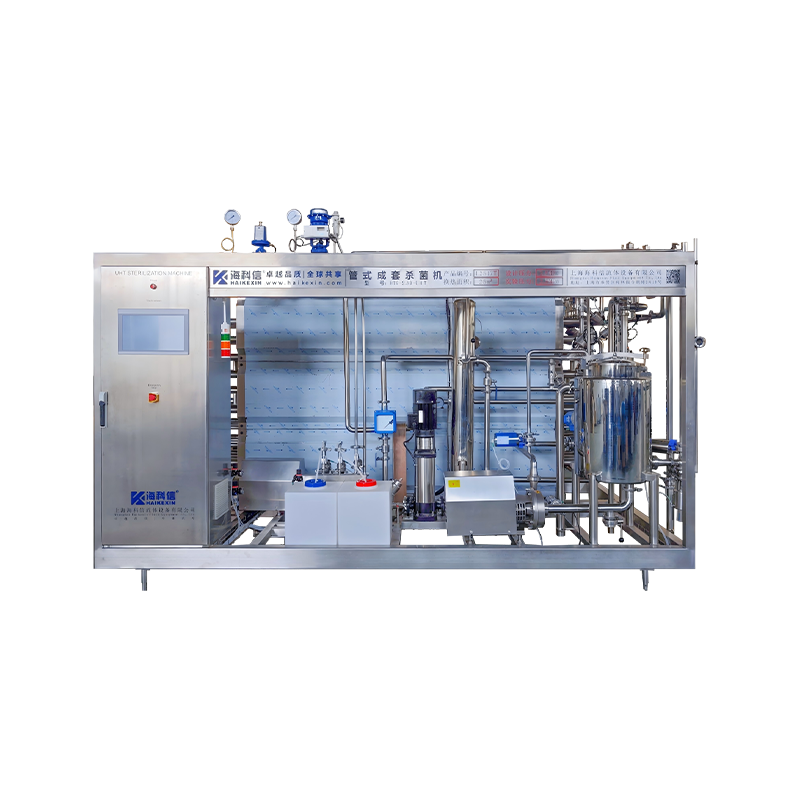
 Custom Automatic UHT Sterilizer for Liquid Food ProcessingReview this custom UHT system for its automated control, CIP compatibility, and cleaning details that support hygiene evidence in the technical bid.View Product →
Check Hygiene and CIP as Hard as Thermal Performance
A UHT skid that cannot be cleaned, drained and verified will fail commissioning even when the thermal design is correct, so hygiene evidence belongs in the technical bid rather than in the commissioning week.
Require these details in writing:
- Product-contact surface finish of 0.8 micron Ra or better, supported by a measurement report rather than a claim, which is the level referenced by 3-A Sanitary Standards and EHEDG guidance.
- Dead legs no longer than twice the branch diameter, and no horizontal run that pools after draining.
- Drain points at every low point, with the slope to each one documented.
- CIP return velocity and the sensor set that confirms conductivity, temperature and time inside the cleaning recipe.
- Separation of aseptic and non-aseptic CIP circuits, plus the steam barrier protecting the sterile side.
- Material certificates to EN 10204 3.1 for product-contact plate and tube, including gasket elastomer specification.
Verification should be witnessed, not promised. A riboflavin test under UV light shows within an hour whether every internal surface is wetted by the cleaning solution. An ATP swab and a pressure-hold test complete the picture. Suppliers who resist the riboflavin test usually know what it will show.
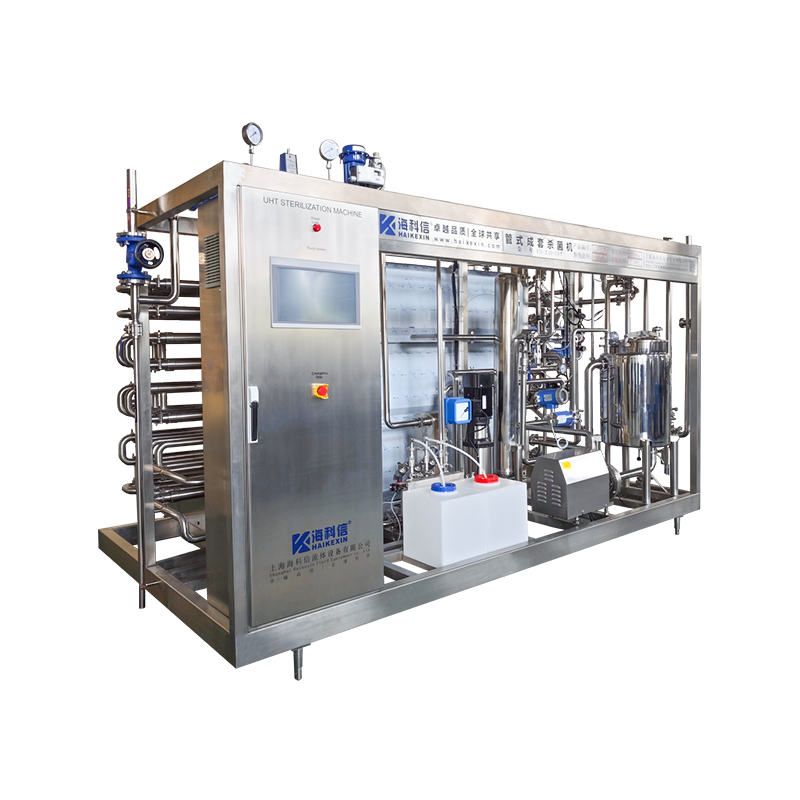
 Food-Grade CIP System for Pipeline and Tank CleaningThis CIP system supports automated cleaning, data traceability, and stainless-steel construction, making its verification evidence relevant before factory acceptance and final payment.View Product →
Tie Payment to the Document Package and the Factory Acceptance Test
The document package and a witnessed factory acceptance test are the only durable evidence of how the skid was built, so hold a final payment tranche against both of them.
The minimum document set is the as-built P&ID and instrument list, the residence-time calculation with its calibration certificate, surface-finish and material certificates, pressure and aseptic barrier test records, the CIP and SIP recipe structure, the operating and maintenance manual, a two-year spares list with lead times, and a declaration of conformity for the applicable directives.
At the factory acceptance test, run the skid on water at design flow and confirm flow rate, hold-tube differential pressure, temperature stability at setpoint and the response of the safety thermal limit. Then watch a complete CIP cycle including the return-line conductivity curve. A recipe that reaches temperature but never reaches the conductivity end point is not a validated clean.
Score Suppliers on Evidence, Not Brochure Capacity
Score every bidder on identical weighted criteria, because headline capacity is the easiest number for a supplier to match and the weakest predictor of project outcome.
| Criterion | Weight | Evidence to request |
| Thermal design and residence time | 20% | Hold-tube calculation, flow meter certificate, P&ID |
| Hygienic design and CIP | 15% | Ra report, dead-leg drawing, riboflavin test record |
| Instrumentation and control | 15% | I/O list, control narrative, safety limit architecture |
| Documentation package | 15% | Sample manual, material certificates, CE or UL file |
| After-sales and spares | 15% | Named engineers, contract response time, spares lead time |
| Factory acceptance test | 10% | Written FAT protocol signed before order |
| Commercial terms and lead time | 10% | Scope matrix, Incoterms, milestone schedule |
Two criteria deserve extra scrutiny. Documentation decides how quickly the plant clears its own qualification and audit. After-sales decides how many production days are lost on the first failure. Ask for named service engineers, their location, the response time written into the contract, and lead time on the three most failure-prone parts: the back-pressure valve, the flow meter and the plate gaskets.
Fix the Scope Boundary Before You Sign
Most disputes on UHT projects concern the boundary between supplier and site rather than the equipment itself, so the scope matrix belongs in the contract, not in an email thread.
- Who supplies culinary steam, the steam filter and the condensate return.
- Who supplies chilled water or glycol, and who guarantees temperature and flow at the skid inlet.
- Who supplies compressed air at the required dew point and the cabling from the MCC.
- The interface to the aseptic filler, including signal exchange and responsibility for the aseptic zone.
- Incoterms, currency, payment milestones against documents, and transit insurance.
- Installation supervision days, commissioning days, training hours and documentation language.
- Warranty exclusions and the response time commitment in hours for remote and on-site support.
Shiloc (Shanghai) Industrial Trading Co., Ltd., registered in Fengxian, Shanghai and also known as Shanghai Haikexin Fluid Equipment, supplies integrated process skids and standalone process equipment for food, beverage and biopharma production, combining equipment supply with import, export and engineering services. Its dairy process skid systems and UHT sterilizer range follow the document-and-test logic described above, and the company profile sets out the trading and engineering scope that sits around the hardware.
Heat-transfer and temperature-control units usually belong inside the same package. Quoting them as a separate line is where interface responsibility quietly disappears.
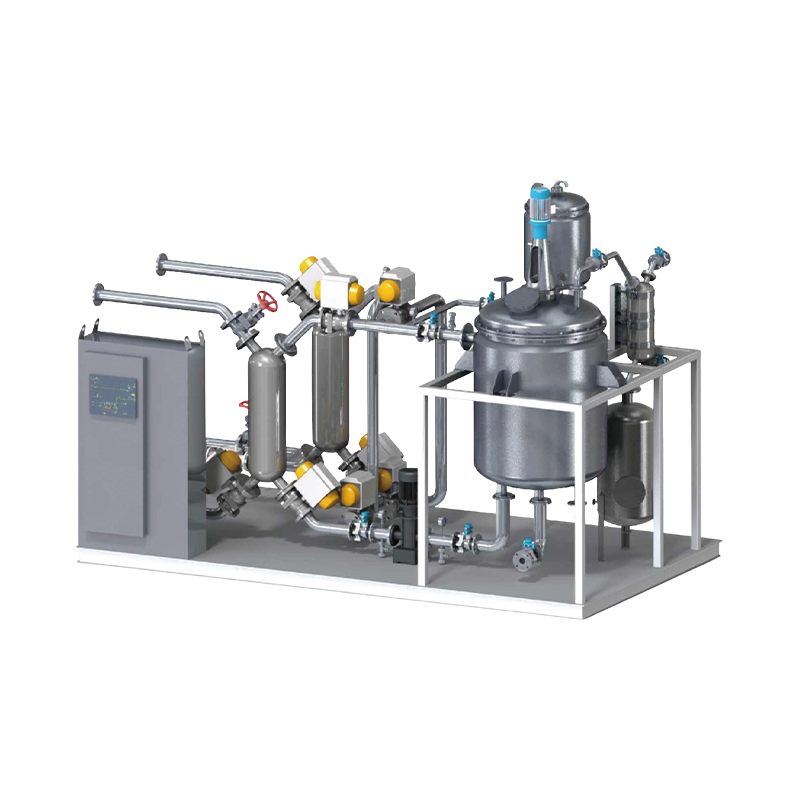
 Skid-Mounted Intelligent Industrial Heat Exchanger UnitThis pre-piped heat exchanger unit provides automated temperature regulation and monitoring, so interface responsibility and thermal performance can be reviewed as one integrated package.View Product →
What hold time should a UHT supplier guarantee for milk?
Low-acid dairy is normally designed around 135 °C to 150 °C with a hold of 2 to 10 seconds, and the exact combination is set by the product and the target shelf life. Require the supplier to state hold-tube volume, design flow and the resulting time on one drawing, and to prove the volume by measurement rather than nominal pipe length.
How can I check CIP coverage before the skid ships?
Witness a riboflavin test under UV light at the factory, then a full cleaning cycle with conductivity, temperature and time records. Request a surface-finish report showing 0.8 micron Ra or better on product-contact parts, and confirm that no dead leg exceeds twice its branch diameter.
Which documents must arrive with the sterilizer?
The minimum set is the as-built P&ID, the hold-tube volume and residence-time calculation, flow meter and temperature sensor calibration certificates, EN 10204 3.1 material certificates, pressure and aseptic barrier test records, the CIP and SIP recipe structure, the operating manual and a declaration of conformity for the applicable directives.
Is the lowest price per litre per hour the right comparison basis?
No. Normalise every bid to the same duty specification first, then add two years of spares, the commissioning days included, the contracted response time and every excluded scope item. A bid that omits culinary steam filtration and one week of commissioning is usually the more expensive option once those items are priced back in.
PREV:UHT Sterilizer vs Pasteurization System: Industrial Processing Differences
NEXT:Bottom-Entry High-Shear Magnetic Emulsifier: Key Shear and Emulsification
NEXT:Bottom-Entry High-Shear Magnetic Emulsifier: Key Shear and Emulsification
Interested in cooperation or have questions?
Recommended LINKS
✦
Automatic UHT Sterilizer for Milk
UHT Processing System for Dairy Products
UHT Sterilizer for Fruit Juice
UHT Processing Equipment for Plant Based Milk
Indirect Heating UHT Sterilizer
Beverage Flash Pasteurization System
automated process skid system for food processing
Food and Beverage Process System
Automatic Milk Pasteurizer
Aseptic Processing Equipment for Liquid Foods
Let'S Work Together Welcome Aboard!
-

haikexin@haikexin.com
+8613391278930
-
 +86-21-57560276
-
 No. 2819, Sihu Road,Fengxian District, Shanghai, China
Join Our Mailing List
Copyright © Shiloc (Shanghai) Industrial Trading Co., Ltd. All Rights Reserved.
Process Systems & Equipment For Food & Biopharma Manufacturers
