
 English
 русский
 Português
 Français


 Read More

Product Category
NEW Category
Contact us
Contact Us
We specialise in the research, development and manufacture of electrical wires and cables.
 +86-21-57560276
CIP System for Food Processing: Key Cleaning Flow and Temperature Requirements
Content
At a dairy plant running a five-stage clean-in-place cycle, the supply line reads 80 C while the return line reads 74 C. The caustic looks correct on the operator screen, but the last 20 m of pipe sees a weaker cleaning temperature. That gap is the practical problem with CIP specifications: flow and temperature are easy to list, yet they must be held at the soil, not at the pump or the tank. A food-grade CIP system is a hydraulic and thermal loop, and its performance depends on velocity, turbulence, return-line temperature, and stage time working together.
What a food-processing CIP system must control
Clean-in-place (CIP) is the automated circulation of water, detergent, and sanitizer through tanks, pipes, valves, and heat exchangers without dismantling the process line, controlled by time, action, chemistry, and temperature. In food processing, the system must wet every product-contact surface, maintain turbulent flow, hold detergent concentration inside the validated band, and keep return-line temperature stable for the full contact time.
Core definition: CIP performance is the product of four variables: time, action, chemistry, and temperature. If one variable drops below its validated range, the other three must compensate, and most food plants do not have that margin.
The table below gives practical starting points for a food-grade skid. These are not universal setpoints: soil type, water hardness, surface finish, and circuit geometry still decide the final recipe.
| Stage | Temperature | Flow target | Contact time | Purpose |
| Pre-rinse | 40-50 C | 1.5-2.1 m/s | 3-5 min | Remove loose product |
| Caustic wash | 70-80 C | 1.5-2.1 m/s | 10-20 min | Remove fat and protein |
| Intermediate rinse | 40-60 C | 1.5-2.1 m/s | 3-5 min | Carry away detergent |
| Acid wash | 55-65 C | 1.5-2.1 m/s | 8-15 min | Remove mineral scale |
| Final rinse | 20-25 C | 1.5-2.1 m/s | 3-5 min | Remove acid residue |
| Sanitizer | 20-25 C | 1.5-2.1 m/s | 5-10 min | Reduce microbial load |
Flow requirements: turbulence, velocity, and dead legs
Food-grade CIP circuits normally target 1.5-2.1 m/s in pipes from 25 mm to 100 mm, which keeps the flow turbulent and gives the detergent enough shear to lift soil from the pipe wall. The exact setpoint depends on diameter and circuit length, but the design rule is stable: size the CIP pump around the worst-case circuit, not around tank volume alone.
For Newtonian fluids, cleaning circuits are usually designed for turbulent flow, with a Reynolds number above 10,000 as a practical target. Below that range, detergent chemistry is doing work that mechanical action should be doing. The hydraulic review should confirm pressure drop at the farthest valve, not only at the pump discharge.
Flow check: A circuit that reaches 1.5 m/s at the CIP skid may fall below 1.0 m/s at the last branch. Confirm velocity at the farthest point, then check return-line temperature and conductivity at the same location.
Dead legs are the other common flow failure. EHEDG hygienic design guidance limits dead-leg length to 1.5 pipe diameters; longer stubs create a low-velocity pocket that rinses poorly and can hold product residue. Use the following checks during hydraulic review:
- Confirm the farthest branch receives at least 1.5 m/s under the validated recipe.
- Calculate pressure drop at both 1.5 m/s and 2.1 m/s before selecting the pump.
- Match spray devices to tank diameter and required impact, not to the largest available nozzle.
- Eliminate dead legs or shorten them to 1.5 pipe diameters or less.
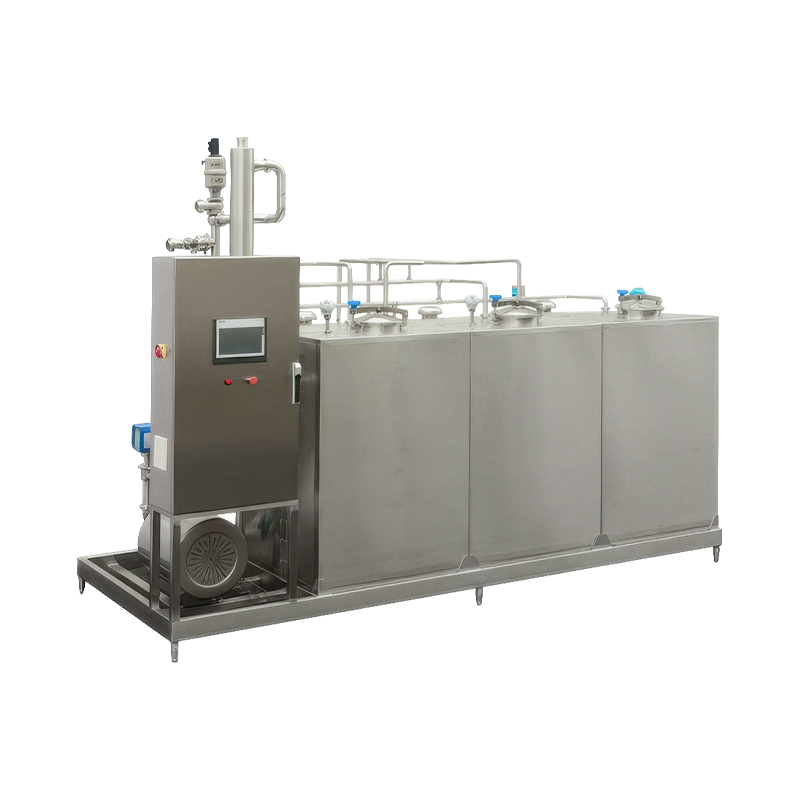
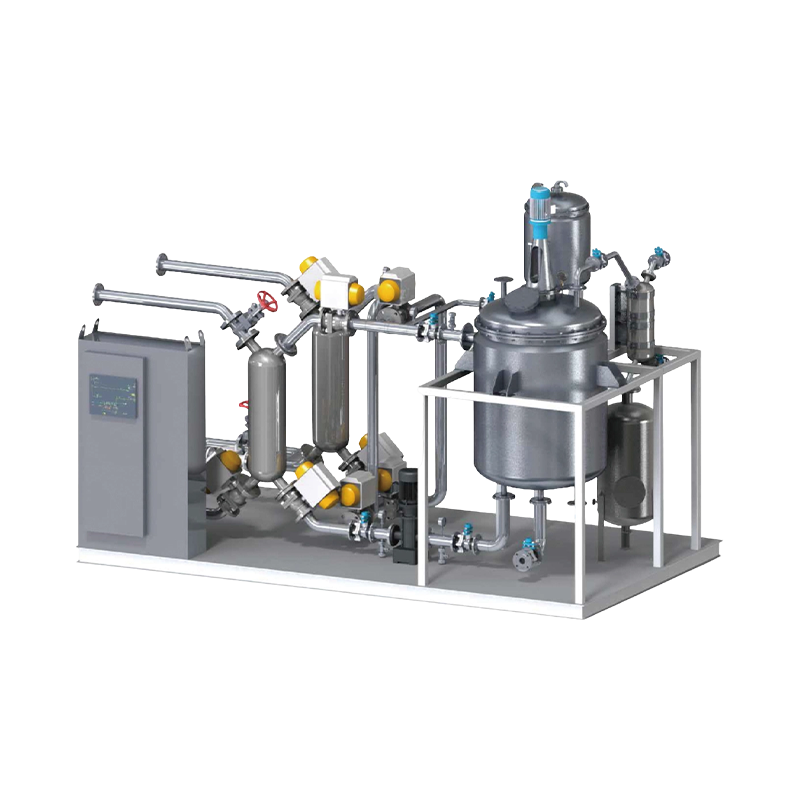
A food-industry CIP process skid should be selected with the circuit drawing attached, because pump head, return-line sensor location, and valve layout decide whether the skid can hold flow at the end of the line. See the CIP process skid system for the food industry for an example of how these elements are packaged.
 Food-Grade CIP Process Skid SystemThis CIP system automates cleaning of food processing lines with PLC control and traceability, helping maintain required temperatures and flow rates for effective sanitation.View Product →
Temperature requirements by cleaning stage
Caustic cleaning in food processing usually runs at 70-80 C, acid cleaning at 55-65 C, and sanitizer at 20-25 C; the return line must hold those bands for the full contact time. Temperature does not replace chemistry or flow. A 5 C drop at the return line can reduce caustic activity on fat and protein films, especially in the last branches of a long circuit.
1.5-2.1 m/sTypical pipe velocity target
70-80 CCaustic wash band at return line
10-20 minTypical caustic contact time
Typical temperature windows in a five-stage CIP cycle
Pre-rinse
40-50 C
Caustic wash
70-80 C
Intermediate rinse
40-60 C
Acid wash
55-65 C
Final rinse
20-25 C
Measure temperature at the return line. A supply-line sensor protects the heater; a return-line sensor protects the product.
For dairy and fat-containing foods, caustic above 80 C can promote protein burn-on, so the upper end of the band matters as much as the lower end. For sugar-based beverages, a lower caustic temperature may be sufficient, but the validated band should come from the detergent supplier and a soil trial, not from a generic recipe.
Matching flow and temperature to the soil
Protein and fat soils need higher temperature and longer alkaline contact than sugar and mineral soils; one CIP recipe across a multi-product line is a common source of validation failure. The comparison below is a starting point for recipe development, not a substitute for swab and rinse-water testing.
Protein and fat soils
Dairy, meat, and sauce lines typically need caustic at 70-80 C, 15-20 min contact, and 1.5-2.1 m/s. Acid at 55-65 C removes milk stone and mineral scale. Pre-rinse at 40-50 C prevents protein set before the alkaline step.
Sugar and mineral soils
Beverage and syrup lines often run caustic at 60-70 C with 8-12 min contact. Acid at 55-60 C targets mineral scale. Final rinse at 20-25 C protects product flavor and confirms detergent removal.
Use the lowest temperature that passes validation, not the highest number in the supplier manual. Energy cost and heat-exchanger fouling rise quickly above the required band, and overheating can bake soil onto hot surfaces.
Design details that hold flow and temperature on target
A CIP skid holds flow and temperature only when the pump, heater, sensors, and control logic are sized as one system; adding a larger pump to a fixed nozzle set can raise pressure without improving coverage. The following design choices decide whether the recipe is repeatable:
- Use a variable-frequency drive on the CIP pump with flow feedback from a sanitary flow meter.
- Control temperature with a plate heat exchanger or steam injector, and trim it using the return-line sensor.
- Place conductivity sensors for detergent concentration and rinse endpoint on the return line.
- Use a sanitary centrifugal pump with a drainable casing and balanced return piping.
Shiloc (Shanghai) Industrial Trading Co., Ltd. supplies food-grade CIP systems and sanitary heat-transfer equipment for these circuits. A skid should be specified with the circuit volume, worst-case pressure drop, detergent type, and required return-line temperature, because those four values set pump head, heater duty, and control valve size.
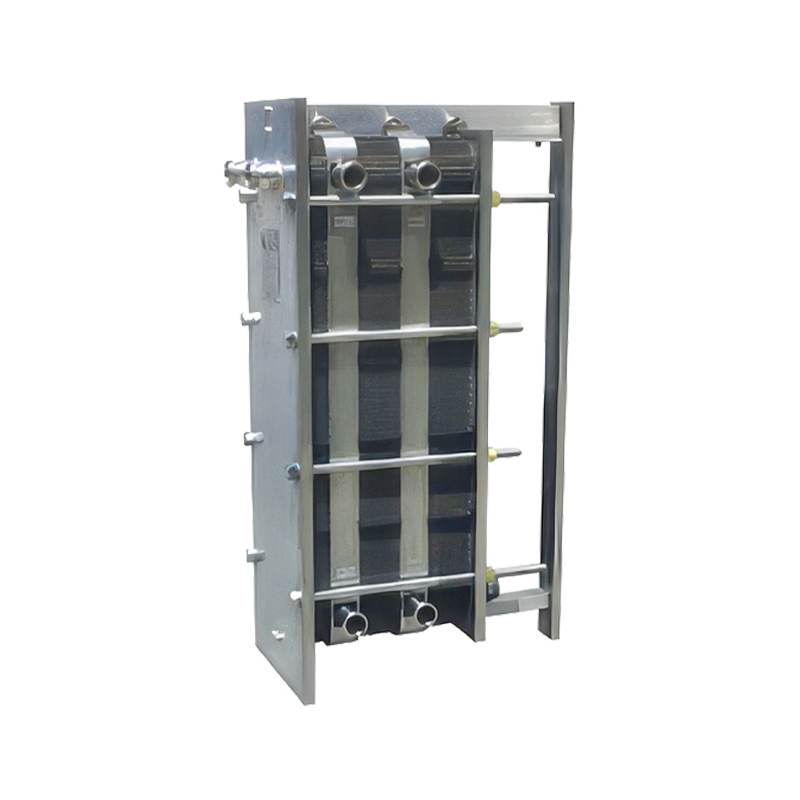 Sanitary Plate Heat Exchanger for Hygienic ApplicationsA detachable plate heat exchanger with food-grade plates and gaskets, suitable for holding process temperatures in CIP recirculation and other hygienic heating or cooling duties.View Product →
Temperature control is often the limiting factor on a skid. A sanitary plate heat exchanger with a close approach temperature can hold the caustic band during recirculation, while a steam injector may suit high-flow circuits with less risk of fouling. The sanitary process skid layout should keep the return-line sensor downstream of the last branch and upstream of the CIP tank.
Verification and common failure points
Verify CIP performance with conductivity, temperature, flow, and contact-time records for every circuit, not with a single pass-or-fail swab at the end. Records should show the return-line temperature, flow rate, detergent concentration, and stage duration for the worst-case circuit, and they should align with FDA 21 CFR Part 117 current good manufacturing practice requirements for food processors.
A CIP validation record should prove four things at the same time: the return line reached temperature, the circuit reached flow, the detergent reached concentration, and the stage lasted long enough.
Common failure points include air pockets at high points, undersized return piping, sensors placed on the supply line, dead legs longer than 1.5 pipe diameters, and spray devices that are too small for the tank. Each of these can make a recipe look correct on the human-machine interface while the product-contact surface remains under-cleaned.
How fast should CIP flow be in a 50 mm pipe?
A 50 mm food-processing pipe usually needs 1.5-2.1 m/s, which corresponds to about 11-15 m3/h depending on exact diameter and pressure drop. Confirm the value at the farthest branch, not at the pump discharge.
What temperature should caustic CIP run at?
70-80 C at the return line for dairy and fat-containing foods; 60-70 C may be enough for sugar-based beverage soils, but the validated band should be set by the soil and detergent supplier. A 5 C drop at the return line can reduce cleaning performance.
How long should a CIP cycle take?
Typical food-processing cycles run 45-90 minutes for a five-stage sequence, with 10-20 minutes of caustic contact and 8-15 minutes of acid contact. Contact time must start after the return line reaches setpoint and concentration, not when the pump starts.
Does every CIP cycle need an acid step?
No. Acid is used when mineral scale or milk stone is present; many dairy plants run acid less frequently than caustic, but the frequency must be validated. A water rinse alone does not remove mineral scale.
PREV:Bottom-Mounted Multi-Impeller Magnetic Mixers: Key Mixing and Process Control Factors
NEXT:Tube In Tube Heat Exchanger: Thermal Performance and Process Requirements
NEXT:Tube In Tube Heat Exchanger: Thermal Performance and Process Requirements
Interested in cooperation or have questions?
Recommended LINKS
✦
CIP Skid System for Food Industry
Food Processing Skid System
Food and Beverage Process System
CIP process skid system for food industry
UHT Processing System for Dairy Products
Aseptic Processing Equipment for Liquid Foods
UHT Processing Equipment for Plant Based Milk
CIP cleaning skid system
Aseptic Beverage Processing Line
Direct Steam Injection UHT System
Let'S Work Together Welcome Aboard!
-

haikexin@haikexin.com
+8613391278930
-
 +86-21-57560276
-
 No. 2819, Sihu Road,Fengxian District, Shanghai, China
Join Our Mailing List
Copyright © Shiloc (Shanghai) Industrial Trading Co., Ltd. All Rights Reserved.
Process Systems & Equipment For Food & Biopharma Manufacturers
