
 English
 русский
 Português
 Français


 Read More

Product Category
NEW Category
Contact us
Contact Us
We specialise in the research, development and manufacture of electrical wires and cables.
 +86-21-57560276
Automatic UHT Sterilizer: Key Temperature & Process Control Requirements
Content
- 1 Why UHT Temperature Control Demands Tight Tolerance
- 2 The Four Control Loops of an Automatic UHT Sterilizer
- 3 Holding Tube Design and Residence Time Validation
- 4 Instrumentation, Sensors, and Fail-Safe Diversion
- 5 CIP and Sanitation for UHT Lines
- 6 Validation, Compliance, and Documentation
- 7 Common Faults and How to Diagnose Them
- 8 Frequently Asked Questions
In a typical dairy plant, an automatic UHT sterilizer runs at 137°C with a 4-second holding time. If the temperature drifts just 1.5°C below setpoint for more than 2 seconds, the flow diversion device sends the batch back to the balance tank for reprocessing. That single event costs yield, energy, and shift time. Getting the process right is not a matter of tweaking one valve; it is a system-level requirement.
Why UHT Temperature Control Demands Tight Tolerance
UHT sterilization is a continuous flow thermal process that must achieve a 12-log reduction of Clostridium botulinum spores while preserving the flavor, protein functionality, and nutrition of the product. The temperature and holding time combination is a safety boundary defined by process authorities, not an operator preference.
A 1°C drop below the target at 140°C can reduce spore kill efficiency by 30-40%. This is why automatic UHT sterilizers are built with several overlapping control layers. One temperature controller is never enough; the system needs redundant sensors, a validated holding tube, and a diversion valve that responds in milliseconds.
How the Temperature-Time Relationship Works
The thermal destruction of spores follows a first-order kinetic model. The D-value shrinks by 90% for every Z-value increase in temperature. For C. botulinum, the Z-value is approximately 10°C. Raising the process temperature from 121°C to 140°C cuts the required holding time from minutes to seconds.
| Process | Temperature | Holding Time | Equivalent F0 |
| Retort (in-container) | 121°C | 15-20 min | At least 3.0 |
| UHT (effective) | 135°C | 25-30 sec | At least 3.0 |
| UHT (milk) | 137°C | 4 sec | At least 3.0 |
| UHT (high-temperature) | 140°C | 2-3 sec | At least 3.0 |
The Four Control Loops of an Automatic UHT Sterilizer
An automatic UHT sterilizer operates on four independent control loops: preheating, final heating, holding, and cooling. Each loop has its own setpoint, response time, and fail-safe logic. A separate flow and backpressure control loop maintains the physical conditions that prevent product flash-boiling.
135-145°CProcessing range
2-5 secHolding time
0.5°CControl tolerance
12-logSpore reduction
The Heating Loop
The heating section raises product from preheat temperature, usually 60-75°C, to the UHT setpoint. In a direct steam injection system, culinary steam mixes into the product for almost instantaneous heating. In an indirect system, a plate or tubular heat exchanger transfers heat from steam or hot water. A PID controller adjusts the steam valve position based on the temperature measured at the heater outlet.
The Holding Loop
After heating, product passes through an insulated holding tube where it stays at the target temperature for the required residence time. This is the most critical zone. If temperature falls below setpoint, the product has not been sterilized.
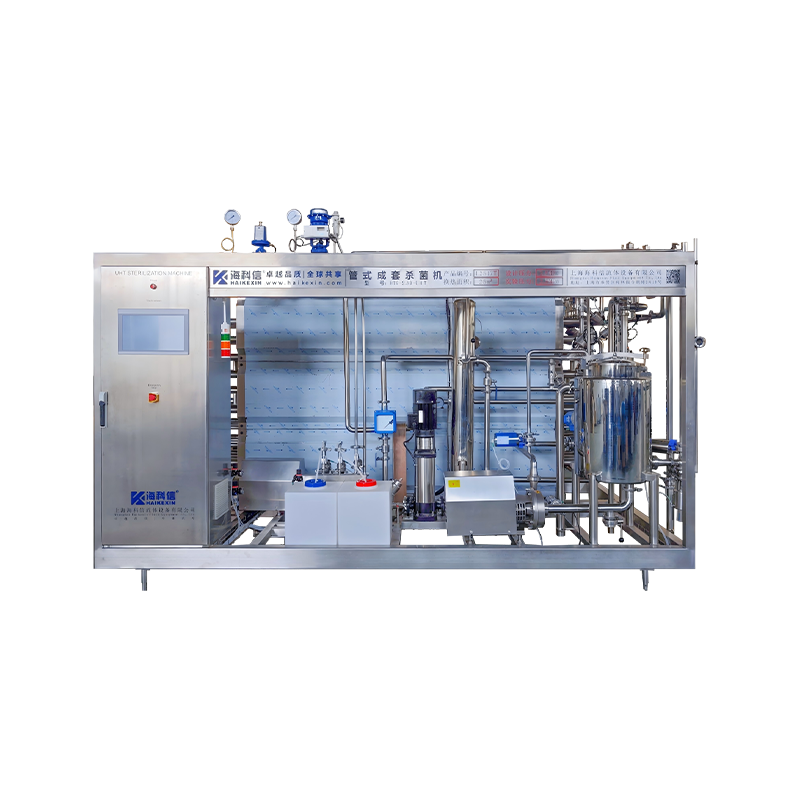
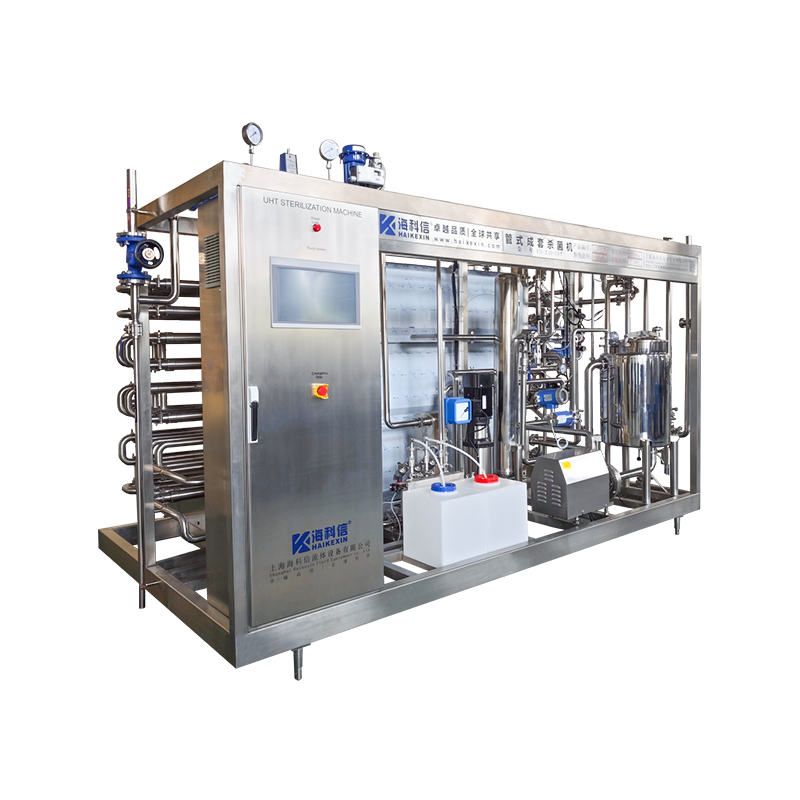
 Automatic UHT Sterilizer for Food and Beverage ProcessingThis automatic ultra-high temperature sterilizer flash-sterilizes beverages while preserving nutrients and flavor. It offers over 85% heat recovery, full automation, and complies with ASME, PMO, and 3A standards, ensuring safe and efficient operation.View Product →
The Cooling Loop
The holding tube discharges into a cooling section. In indirect systems, product flows through a regenerator to recover heat, then into a chilled water or glycol section. Cooling speed matters: too slow adds extra heat damage, too fast creates thermal shock on heat transfer surfaces.
Flow and Backpressure Control
At 140°C, water flashes to steam at roughly 3.6 bar absolute. To keep the product liquid, a backpressure valve downstream of the holding tube must maintain 4-6 bar. A drop below that causes flashing, changes flow velocity, and invalidates the residence time calculation.
The holding tube is the only component that guarantees the defined residence time. Everything upstream is an input; everything downstream is a result.
Holding Tube Design and Residence Time Validation
Operating conditions in the holding tube determine whether every particle of product receives the required thermal treatment. The tube length must be calculated for the fastest-moving particle in the flow profile, not the average velocity.
In turbulent flow, the centerline velocity is about 1.2 times the average velocity. This fastest particle spends the shortest time in the holding tube, so the design equation includes a 1.2 safety factor.
If the average velocity is 2.0 m/s and the required holding time is 4 seconds at 140°C, the theoretical tube length is 8.0 m. With the 1.2 factor, the actual designed length is 9.6 m.
| Parameter | Typical Range | Engineering Reason |
| Tube inner diameter | 25-100 mm | Balances pressure drop and heat transfer |
| Flow velocity | 1.5-4.0 m/s | Keeps Reynolds number above 10,000 |
| Reynolds number | Above 10,000 | Ensures turbulent flow and plug profile |
| Design safety factor | 1.2 | Accounts for fastest-moving particle |
Minimum holding tube length = required time × average velocity × 1.2. This is not a suggestion; it is the design equation.
Instrumentation, Sensors, and Fail-Safe Diversion
A compliant automatic UHT sterilizer uses redundant temperature sensors with a response time below 1.5 seconds and a pneumatic diversion valve that actuates within 200 milliseconds.
For food safety, the process is considered valid only while the product temperature at the holding tube outlet is at or above the setpoint. The moment it drops, a flow diversion device (FDD) redirects the product to the balance tank.
Required Instrumentation
- Dual Pt100 RTD sensors at the holding tube outlet with measurement uncertainty within 0.3°C
- Continuous temperature recording at 1-second intervals with data retained for at least 12 months
- Automatic diversion on any negative deviation below setpoint, with no manual override
- Pressure transmitter at the backpressure valve to maintain 4-6 bar absolute
- Flow meter on the product feed to validate actual flow rate against design value
- Pneumatic diversion valve with 0.2-second actuation time
 Precision Temperature Control Unit for Food and BeverageThis closed-loop TCU regulates temperature for reactors and tanks, supporting heating, cooling, and alternating processes. With PLC control and food-grade stainless steel, it maintains stable temperatures and enables data traceability for quality assurance.View Product →
The Diversion Sequence
On a negative temperature deviation, the system lowers heater output, opens the diversion valve, and routes product back to the balance tank. Modern skids interlock the diversion valve with the pump to prevent a pressure spike in the holding tube.
CIP and Sanitation for UHT Lines
UHT lines require a dedicated CIP program with pre-rinse, hot alkaline wash, intermediate rinse, acid wash, final rinse, and hot water sanitization. Each phase has defined flow rate, temperature, and concentration targets.
The primary challenge is fouling. At high temperatures, milk proteins denature and form burn-on deposits on heat transfer surfaces. These deposits reduce thermal efficiency, alter flow characteristics, and become a microbiological niche. The alkaline wash removes protein and fat, but only an acid wash removes the mineral scale that remains.
| CIP Phase | Temperature | Time | Purpose |
| Pre-rinse | 50-60°C | 10 min | Remove loose product residue |
| Alkaline wash | 75-80°C | 20-30 min | Dissolve proteins and fats |
| Intermediate rinse | 60°C | 10 min | Flush remaining alkali |
| Acid wash | 60-70°C | 15-20 min | Remove mineral scale |
| Final rinse | 60°C | 10 min | Neutralize pH |
| Hot water sanitize | 90-95°C | 15 min | Final microbial sanitization |
 Food-Grade CIP System for Automated In-Line CleaningThis CIP system cleans pipelines and tanks without disassembly, using pre-rinsing, alkaline, acid, and final rinsing cycles. PLC-controlled with traceability, it reduces manual work and cross-contamination risk, suitable for dairy, beverage, and sauce lines.View Product →
A CIP program that skips the acid wash will gradually scale the heater, reducing efficiency and shifting the effective residence time.
Validation, Compliance, and Documentation
UHT process validation per 21 CFR Part 113 and EU Regulation EC 852/2004 requires a documented temperature mapping study, a microbiological challenge test, and recalibration traceability for every sensor.
A proper validation package includes Installation Qualification (IQ), Operational Qualification (OQ), and Performance Qualification (PQ). During PQ, the process is challenged with a product inoculated with a known microbial strain. The results must demonstrate a minimum 12-log reduction with no diversion events during the study period.
Modern UHT skids store process data with a secure audit trail. Ethernet or OPC-UA communication sends data to supervisory systems for batch reporting and third-party audit compliance. For more on how automation is applied in pasteurization systems, see our article on automation in food pasteurization.
Common Faults and How to Diagnose Them
The most frequent UHT process deviations are flow rate drift, sensor drift, steam pressure fluctuation, and fouling of the heating section. These four issues account for most field service calls to processing plants.
Flow Rate Drift
A degrading pump lowers flow rate, which increases residence time and can cause over-heating. A partially blocked valve reduces flow and changes backpressure, leading to under-processing.
Sensor Drift
A Pt100 sensor that reads 1°C lower than the actual product temperature makes the system heat product hotter than intended. A sensor that reads high is more dangerous: the heating loop runs at a lower temperature and under-processes.
Steam Pressure Fluctuation
An undersized steam pressure reducing valve creates oscillation in the heater outlet temperature. A PID controller tuned to a narrow band can become unstable. Proper skid engineering includes a steam conditioning station with a separator and trap.
Fouling of the Heating Section
As fouling increases, the overall heat transfer coefficient drops. The system opens the steam valve further, raising the wall temperature and causing localized burning. Monitoring the pressure drop across the heater is the fastest way to detect fouling progression.
Most UHT failures are invisible until they cause a diversion. Monitoring pressure drop and sensor drift prevents costly downtime.
Selecting an automatic UHT sterilizer is an engineering decision, not a procurement exercise. The right system will hold tight control tolerance, use validated holding tube geometry, and document diversion logic. The team at Shiloc (Shanghai) Industrial Trading Co., Ltd. designs integrated UHT skids for food and beverage processors. Talk to them about your product, capacity, and heating method on our contact page.
Frequently Asked Questions
What is the minimum holding time for UHT sterilization?
The minimum holding time depends on the target temperature. At 135°C, the holding time is typically 25-30 seconds. At 140°C, it drops to 2-5 seconds. The standard dairy formula is 137°C for 4 seconds, which delivers a 12-log reduction of Clostridium botulinum spores.
What happens if the UHT temperature drops below the setpoint?
The temperature sensor at the holding tube outlet detects the drop, and the flow diversion device immediately redirects the product to the balance tank. This unsterilized product is re-processed. The system records the diversion event in the batch log for food safety audits.
How often should UHT sterilizer sensors be calibrated?
Temperature sensors should be calibrated at least every 6 months, or more frequently if the manufacturer recommends it. Calibration should be checked against a traceable reference standard and documented for audit traceability.
What is the difference between UHT and pasteurization?
Pasteurization uses lower temperatures, typically 72-85°C, with holding times from 15 seconds to several minutes, and is designed to eliminate pathogens while keeping the product refrigerated. UHT uses high temperatures, 135-150°C, with very short holding times, 2-5 seconds, to achieve commercial sterility and allow shelf-stable storage.
PREV:Bioprocess Skids for Cell Culture: Design, Validation, and Procurement Essentials
NEXT:Bioprocess Skids for Pharmaceutical R&D: Design, Selection & Procurement Guide
NEXT:Bioprocess Skids for Pharmaceutical R&D: Design, Selection & Procurement Guide
Interested in cooperation or have questions?
Recommended LINS
✦
Automatic UHT Sterilizer for Milk
UHT Processing Equipment for Plant Based Milk
UHT Processing System for Dairy Products
UHT Sterilizer for Fruit Juice
Process Skid System
Sanitary Process Skid
Skid Mounted Process System
Food and Beverage Process System
Food Processing Skid System
food and beverage process skid system
Let'S Work Together Welcome Aboard!
-

haikexin@haikexin.com
+8613391278930
-
 +86-21-57560276
-
 No. 2819, Sihu Road,Fengxian District, Shanghai, China
Join Our Mailing List
Copyright © Shiloc (Shanghai) Industrial Trading Co., Ltd. All Rights Reserved.
Process Systems & Equipment For Food & Biopharma Manufacturers
