
 English
 русский
 Português
 Français


 Read More

Product Category
NEW Category
Contact us
Contact Us
We specialise in the research, development and manufacture of electrical wires and cables.
 +86-21-57560276
Bottom-Mounted Magnetic Mixers: Key Mixing Performance and Hygienic Requirements
Content
A dairy plant that swaps a top-entry agitator for a bottom-mounted magnetic mixer typically eliminates the most common leak point on the tank and cuts cleaning time by a measurable margin. The drive principle is simple: the motor turns an outer magnetic rotor, and the impeller follows it through a welded containment shell, so no shaft penetrates the vessel bottom and no dynamic seal exists at all.
Definition. A bottom-mounted magnetic mixer is a hygienic agitation device in which the impeller is driven by a magnetic coupling through a stationary containment plate, replacing the rotating shaft penetration and mechanical seal with a fully enclosed, seal-less drive train.
What Defines a Bottom-Mounted Magnetic Mixer
Every bottom-mounted magnetic mixer is built around four functional elements: an outer magnetic rotor driven by the motor, a static containment shell, an inner magnetic rotor that carries the impeller, and one or more hygienic impellers selected for the process duty. Because the containment shell is welded flush into the tank bottom, the wetted chamber stays completely closed.
The magnetic coupling does more than transmit torque. It acts as a built-in torque limiter: if the impeller jams, the magnets slip instead of overloading the gearbox or shaft. This protects the drive train and prevents the kind of mechanical failure that would force a batch to be discarded.
- Containment shell: 316L stainless steel, dimpled to reduce eddy-current losses, welded flush with the tank bottom.
- Inner rotor: permanent magnets encapsulated in a smooth, polished casing with no exposed fasteners.
- Impeller system: single or multiple impellers on a short shaft sized for the vessel geometry.
- Drive unit: motor and gearbox matched to the required torque range and CIP/SIP duty.
Compared with top-mounted and side-mounted agitators, the bottom-mounted configuration changes both the mechanical and hygienic picture.
| Configuration | Seal requirement | Typical duty | Main advantage | Main limitation |
| Bottom-mounted magnetic | None | Blending, suspension, dissolution | Leak-free, self-draining | Torque limited by magnet size |
| Top-mounted | Mechanical seal | Wide duty range | High torque available | Long shaft, seal leak risk |
| Side-mounted | Mechanical seal | Large storage tanks | Low headroom | Seal maintenance, weak turnover at low level |
Mixing Performance: The Parameters That Matter
Three numbers define the mixing performance of a bottom-mounted magnetic mixer: tip speed, power number, and circulation flow. A fourth, turn-down ratio, determines how flexibly the mixer can follow changing process conditions. Tip speed is the tangential velocity at the impeller edge, and for axial-flow impellers in blending duty it typically ranges from 2.5 to 5.0 m/s.
Power number (Np) describes the impeller resistance in a turbulent flow field, while flow number (Nq) measures pumping capacity. Together, Np and Nq let a process engineer predict blend time, solids suspension, and heat transfer coefficients before installation.
2.5-5.0 m/s
Typical tip speed, blending
0.30-1.27
Power number (Np) range
0.40-0.79
Flow number (Nq) range
10:1
Typical turn-down ratio
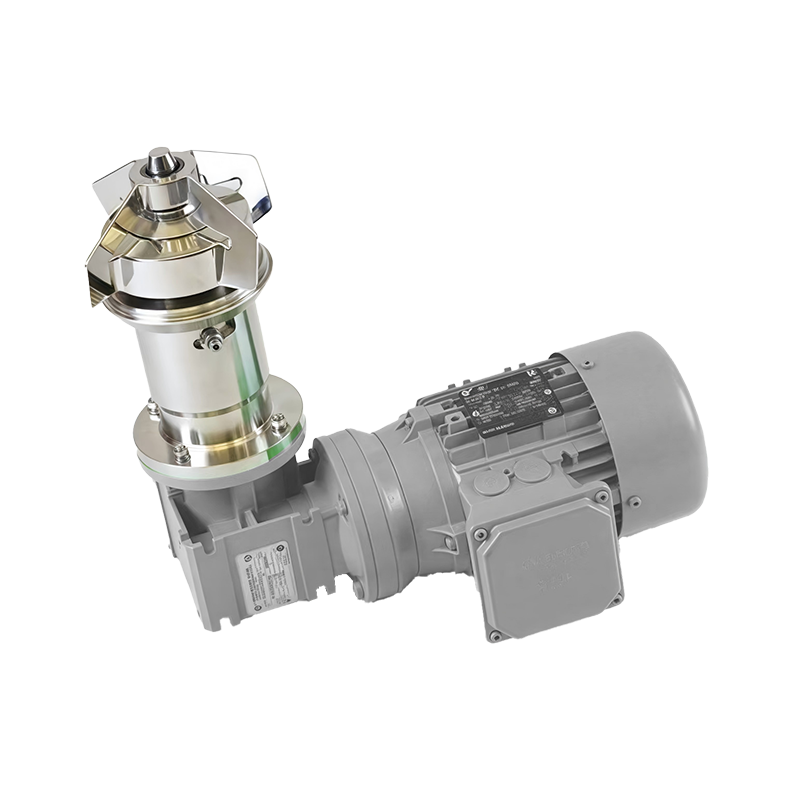
 Bottom-Mounted Magnetic Mixers for Bioprocessing ApplicationsThis mixer leverages impeller geometry to balance axial circulation and shear, making it a practical choice when translating Np and Nq predictions into reliable blend times, suspension, and heat transfer performance.View Product →
Impeller geometry is the largest lever. A pitched-blade turbine delivers strong axial circulation, a hydrofoil produces high flow at lower shear, and a high-shear disc is reserved for emulsification and particle-size reduction.
| Impeller type | Power number Np | Flow number Nq | Tip speed (m/s) | Best suited for |
| Pitched-blade turbine | 1.27 | 0.79 | 3.0-4.5 | Blending, solids suspension |
| Hydrofoil impeller | 0.30-0.35 | 0.56-0.73 | 2.5-4.0 | Low-shear blending, heating and cooling |
| Marine propeller | 0.35 | 0.62 | 3.5-5.0 | Tank turnover, large volume circulation |
| High-shear disc | 5.0 | 0.40 | 8.0-12.0 | Emulsification, fine dispersion |
Circulation flow number by impeller type
Hygienic Design Requirements: What Cleanable Really Means
Hygienic compliance is determined by surface finish, drainability, CIP/SIP compatibility, and the absence of dead zones where product can stagnate. Food and biopharma plants assess these requirements against 3-A Sanitary Standards, EHEDG guidelines, and FDA regulations for food-contact surfaces.
- Surface roughness Ra 0.4 micron or better for food contact; Ra 0.25 micron or better for biopharma contact parts, with electropolishing documented.
- Drainability: tank bottom slope of at least 2 degrees toward the outlet; impeller and containment shell must not trap liquid when empty.
- Dead-zone elimination: static O-rings fully retained, no threaded fasteners inside the wetted chamber, containment shell flush-welded.
- CIP/SIP tolerance: wetted materials must survive caustic and acid wash cycles plus pure steam up to 140 degrees Celsius.
- Material certification: 316L stainless steel with EN 10204 3.1 certificates; EPDM or FFKM elastomers.
Rule of thumb. Surface roughness Ra 0.4 micron is the dividing line for bacterial cleanability: above it, organisms such as Listeria monocytogenes find anchor points in scratches; below it, standard CIP flow reliably removes product residues.
The same cleaning logic that governs automation in food pasteurization applies upstream in the mixing vessel: every wetted surface must be reachable by cleaning solution at the right flow rate and temperature.
Food, Beverage, and Biopharma: Different Duty, Same Hygienic Core
Food and beverage processors buy bottom-mounted magnetic mixers for cleaning speed and batch flexibility, while biopharma users specify the same configuration for sterile containment and validation simplicity. Both industries share the same hygienic core, but the emphasis differs.
Food and Beverage
- Rapid batch turnover in blending, dissolving, and rework tanks.
- Frequent product changeovers handled by aggressive CIP regimes.
- 3-A or EHEDG design, with optional explosion-proof motors for solvent-based flavor systems.
- Single- or multi-impeller layouts for widely varying liquid levels.
Biopharma
- Sterile mixing for media, buffer, and intermediate product.
- SIP cycles up to 140 degrees Celsius with silicon-free elastomers.
- Full documentation: weld logs, surface finish certificates, IQ/OQ test reports.
- Compact wetted volume to minimize product loss and batch deviation.
For emulsified sauces and liquid dairy blends, the magnetic bottom entry is not limited to low-shear duty. A magnetic emulsifier operating at high speed can produce droplet sizes below 5 microns when configured with the correct rotor-stator geometry.
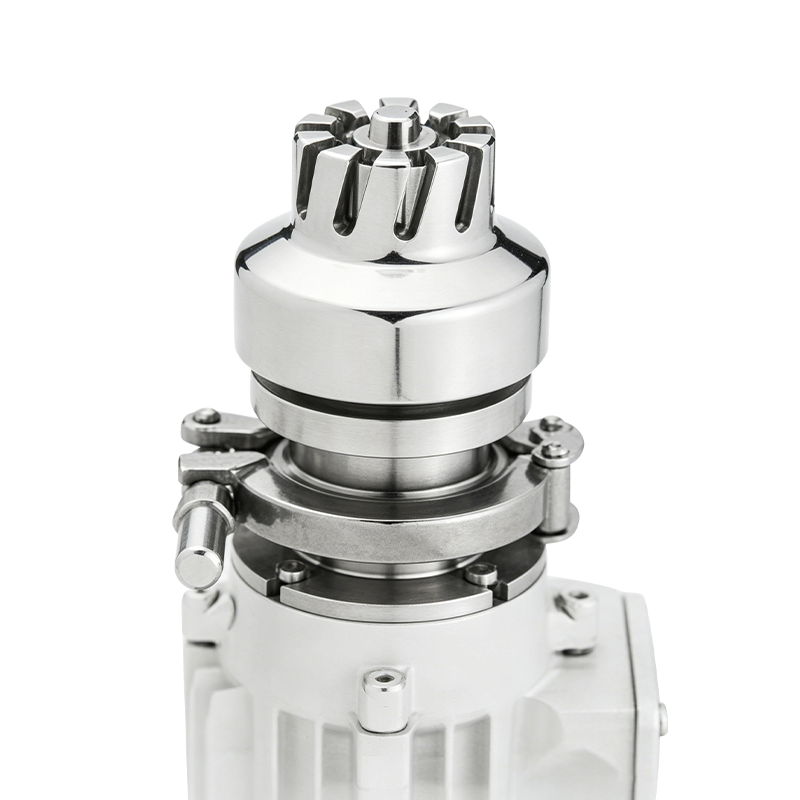
 Bottom-Entry High-Shear Magnetic EmulsifierEngineered for fine emulsification with rotor-stator action, this unit achieves sub-5-micron droplets. Review it here to see how magnetic drive and hygienic design simplify high-shear processing in closed systems.View Product →
How to Specify a Bottom-Mounted Magnetic Mixer
Write the specification in six steps: define the mixing duty, fix the vessel geometry, select the impeller, assign the hygienic class, size the drive, and agree on validation documentation. Skipping any one of these steps is the most common cause of a mixer that works on paper but fails in production.
- Define the mixing duty: target blend time, suspension class, or heat transfer coefficient, plus the full range of liquid heights and viscosities.
- Fix vessel geometry: bottom slope, outlet position, baffle arrangement, and nozzle locations determine where the impeller must sit.
- Select impeller type and count: axial-flow impellers for turnover, hydrofoils for low shear, high-shear elements for emulsification.
- Assign the hygienic class: Ra value, material grade, elastomer compatibility, and the maximum CIP/SIP temperature.
- Size the drive: calculate motor power from Np and tip speed, then verify breakaway torque at full liquid density.
- Agree on documentation: surface finish reports, material certificates, welding records, and a magnetic coupling test certificate.
Specification tip. A reliable supplier provides a written mixing duty statement plus a factory test certificate confirming torque, speed range, and surface finish before shipment.
Shiloc (Shanghai) Industrial Trading Co., Ltd. covers this duty with bottom-mounted magnetic mixers in the standalone process equipment range for food and beverage, supported by engineering, manufacturing, and import-export services.
Frequently Asked Questions
What is the biggest advantage of a bottom-mounted magnetic mixer?
The absence of a dynamic shaft seal. Because the impeller is driven magnetically through a welded containment shell, there is no rotating shaft penetration and no mechanical seal leak path, which improves plant safety, product integrity, and cleanability at the same time.
Can a bottom-mounted magnetic mixer handle high-viscosity products?
Yes, within the torque limits of the magnetic coupling. Products up to roughly 10,000 mPa.s can be blended with axial-flow impellers at reduced speed; above that range, a double-impeller configuration or a high-shear magnetic emulsifier is recommended.
How is a bottom-mounted magnetic mixer cleaned in place?
The tank is drained completely because the mixing chamber is self-draining, then a standard CIP sequence of pre-rinse, caustic, acid, and final rinse is applied. For biopharma duty, an SIP hold at 121 to 140 degrees Celsius follows the CIP cycle.
What surface finish is required for a hygienic bottom-mounted magnetic mixer?
Food-contact surfaces typically require Ra at or below 0.4 micron with mechanical polishing, while biopharma contact surfaces are electropolished to Ra at or below 0.25 micron. Both require documented verification.
PREV:Bioprocess Skid Piping: Key Hygienic and Process Requirements for Biopharma
NEXT:UHT Sterilizer vs Pasteurization System: Industrial Processing Differences
NEXT:UHT Sterilizer vs Pasteurization System: Industrial Processing Differences
Interested in cooperation or have questions?
Let'S Work Together Welcome Aboard!
-

haikexin@haikexin.com
+8613391278930
-
 +86-21-57560276
-
 No. 2819, Sihu Road,Fengxian District, Shanghai, China
Join Our Mailing List
Copyright © Shiloc (Shanghai) Industrial Trading Co., Ltd. All Rights Reserved.
Process Systems & Equipment For Food & Biopharma Manufacturers
