
 English
 русский
 Português
 Français


 Read More

Product Category
NEW Category
Contact us
Contact Us
We specialise in the research, development and manufacture of electrical wires and cables.
 +86-21-57560276
Bottom-Entry High-Shear Magnetic Emulsifier: Key Shear and Emulsification
Content
- 1 What Is a Bottom-Entry High-Shear Magnetic Emulsifier?
- 2 Shear Requirements That Control Droplet Breakup
- 3 Emulsification Requirements for Stable Dispersions
- 4 Why Bottom-Entry Magnetic Coupling Matters in Hygienic Lines
- 5 How to Select a Bottom-Entry Emulsifier for Your Process
- 6 Frequently Asked Questions
A dressing manufacturer in Jiangsu reported batch-to-batch viscosity drift in a 1,500 L oil-in-water emulsion because a top-entry agitator drew air through its mechanical seal and could not deliver enough shear at the tank bottom, where the dense aqueous phase pooled. Within two months, 6 percent of finished batches failed the standard centrifugal stability test. The failures stopped only after the line was converted to a bottom-entry high-shear magnetic emulsifier with a magnetically coupled rotor-stator generator mounted through the vessel bottom.
This article breaks down the key shear and emulsification requirements that determine whether a bottom-entry magnetic emulsifier will meet your specification: rotor tip speed, rotor-stator gap, power density, droplet size targets, viscosity limits, and hygienic design. It is written for process engineers, production managers, and plant project teams evaluating this equipment class for a new line or a retrofit.
What Is a Bottom-Entry High-Shear Magnetic Emulsifier?
A bottom-entry high-shear magnetic emulsifier is a tank-mounted rotor-stator mixing device driven by a magnetic coupling through the bottom of the vessel, with the motor located below the tank and the rotor-stator generator inside the product. It draws the liquid phases into a narrow gap between a rotating rotor and a stationary stator, dispersing one phase into the other as droplets typically between 1 and 10 microns in diameter.
Core definition
High-shear emulsification is the mechanical dispersion of one immiscible liquid into another as stable droplets, achieved by forcing the mixture through a high-velocity rotor-stator gap where shear stress and turbulence break the dispersed phase into smaller droplets.
The magnetic coupling separates the wet and dry zones with a static containment shell: permanent magnets on the motor side drive internal magnets on the impeller shaft without any shaft penetration through the vessel wall. This removes the mechanical seal that is the most common source of leakage, air ingress, and unplanned downtime in conventional top-entry emulsifiers.
Core components of a complete unit include:
- Rotor-stator generator sized for the batch volume and product viscosity
- Magnetic coupling with a static containment shell
- Bottom flange with a hygienic gasket and full drainability
- Variable-frequency drive for tip speed control
- CIP and, where required, SIP connections
At Shiloc (Shanghai) Industrial Trading Co., Ltd., these units belong to a broader family of standalone process equipment for the food and beverage industry, which also includes bottom-mounted magnetic mixers, plate heat exchangers, and shell-and-tube heat exchangers for the same hygienic process lines.
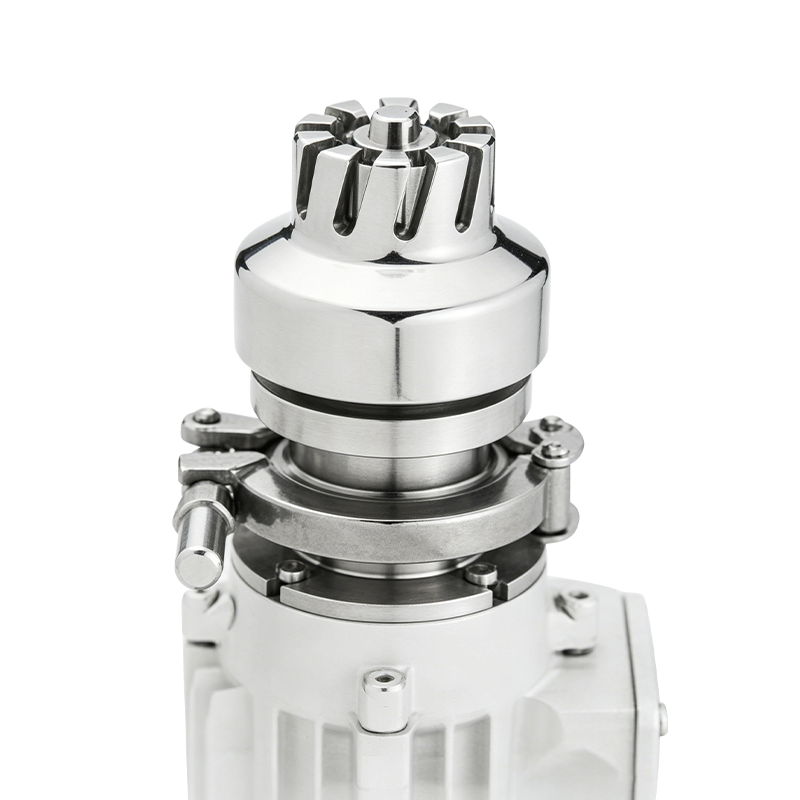
 Bottom-Entry High-Shear Magnetic Emulsifier for Hygienic ProcessingThis FDA-compliant magnetic drive emulsifier suits high-viscosity batches and prevents cross-contamination. Its rotor-stator gap and speed range are key to achieving the nominal shear rates discussed, making it relevant for emulsion formulation.View Product →
Shear Requirements That Control Droplet Breakup
Nominal shear rate, not motor power alone, controls droplet breakup in a high-shear emulsifier. Shear rate is calculated as tip speed divided by the rotor-stator gap. Tip speed is the rotor circumference multiplied by rotational speed: a 300 mm rotor at 2,500 RPM produces a tip speed of about 39 m/s, and with a 0.5 mm gap the nominal shear rate is approximately 78,000 per second.
Nominal shear rate at 30 m/s tip speed, by rotor-stator gap width
1.0 mm gap 30,000 per second
0.5 mm gap 60,000 per second
0.2 mm gap 150,000 per second
Five factors define the practical shear available in a production unit:
- Rotor diameter and rotational speed set the tip speed; larger diameters generate both higher shear and higher pumping flow.
- Rotor-stator gap from 0.2 to 1.0 mm controls maximum droplet size; smaller gaps give finer droplets but reduce throughput and add heat to viscous products.
- Multiple concentric rows of teeth on rotor and stator increase the number of shear events per revolution.
- Recirculation time and number of passes matter as much as instantaneous shear in batch emulsification.
- Nominal shear rate is geometric; the actual shear stress depends on product viscosity at the operating temperature.
Engineer's note: Halving the rotor-stator gap doubles the nominal shear rate at the same tip speed, but it also halves the flow area. A unit specified purely on gap size will produce fine droplets slowly and overheat heat-sensitive products. Balance gap, speed, and residence time together.
Emulsification Requirements for Stable Dispersions
A stable emulsion is the result of three coordinated variables: droplet size below a formulation-critical threshold, a narrow droplet size distribution, and interfacial stabilization by the correct emulsifier at the correct concentration. The emulsifier type and hydrophilic-lipophilic balance (HLB) value determine the interfacial film strength; the dose is typically 0.5 to 5 percent of the oil phase. The dispersed phase should be as low in viscosity as practical, and the volume fraction of the dispersed phase is normally limited to about 70 to 80 percent in rotor-stator machines without special impeller designs.
Emulsification requirement
The combination of energy input, residence time, and surfactant chemistry that produces a droplet size distribution stable for the full shelf life of the finished product.
Adding energy beyond the point where droplet size stops decreasing does not improve stability; it only heats the product. The correct specification matches the shear input to the formulation chemistry. The table below summarizes the parameters a supplier needs to size the machine correctly.
| Parameter | Typical range | Why it matters |
| Rotor tip speed | 20 to 40 m/s | Sets the peak shear rate available at the rotor-stator gap |
| Rotor-stator gap | 0.2 to 1.0 mm | Controls the maximum droplet size produced |
| Power density | 1 to 10 kW per 1,000 L | Determines batch processing time and temperature rise |
| Dispersed phase viscosity | Up to 5,000 mPas | Limits how well the phase can be drawn through the rotor |
| Continuous phase viscosity | Up to 50,000 mPas | Requires impeller or scraper assistance above the range |
| CIP temperature | Up to 95 C | Confirms gasket and magnetic assembly compatibility |
| SIP temperature | Up to 140 C | Required for aseptic biopharma emulsion lines |
Why Bottom-Entry Magnetic Coupling Matters in Hygienic Lines
Bottom-entry mounting with a magnetic coupling eliminates the shaft seal, which is the highest-risk component of a traditional top-entry mixer. In a top-entry machine, the rotating shaft passes through the vessel wall or head and requires a mechanical seal. That seal runs in the product, wears over time, can leak process fluid to the environment, and can draw air or cleaning media into the batch. In sterile applications, a failing seal is a contamination event that requires line shutdown and revalidation.
A magnetic coupling removes the dynamic seal entirely. The containment shell is a static, welded, polished component, and torque is transferred across it by permanent magnets. Bottom mounting also places the rotor-stator generator directly in the heaviest phase, improves gravity drainability, shortens the shaft, and reduces the headroom needed above the tank.
Bottom-entry magnetic
- No dynamic shaft seal in contact with product
- No seal wear, leakage, or air ingress
- Full gravity drainability through the bottom
- Low headroom, clean exterior, no top platform
- Short shaft reduces vibration at high speed
Top-entry mechanical seal
- Dynamic seal operates in the product
- Seal wear, leakage, and air ingress risk
- Long shaft needs steady bearings and alignment
- Top drive increases clean-room height
- Seal maintenance shortens with shaft speed
Hygiene impact: No shaft seal means no seal fluid, no air ingress, and no mechanical wear particles in the product. This simplifies CIP, removes the most common contamination pathway, and extends maintenance intervals.
How to Select a Bottom-Entry Emulsifier for Your Process
Define four parameters before sending an inquiry: target droplet size, batch volume, viscosity at process temperature, and the required CIP or SIP protocol. A unit selected on motor horsepower alone will rarely meet a particle size specification; the rotor-stator geometry, tip speed, and circulation strategy must match the formulation.
For multiphase products such as mayonnaise, ointment bases, and creams, the pre-mix stage usually requires a separate low-shear bottom-mounted mixer to hydrate thickeners and blend the continuous phase before the emulsifier is started.
- Droplet size target: specify D90, mean diameter, or the QC stability test your laboratory will apply
- Batch volume and tank diameter: confirm that the wet volume fully covers the rotor inlet
- Viscosity of both phases at process temperature, not at filling temperature
- Operating temperature and pressure range, including vacuum deaeration if used
- CIP circuit flow rate and temperature; SIP requirement for aseptic lines
- Documentation needs: material certificates, surface finish certificates, and FAT protocol
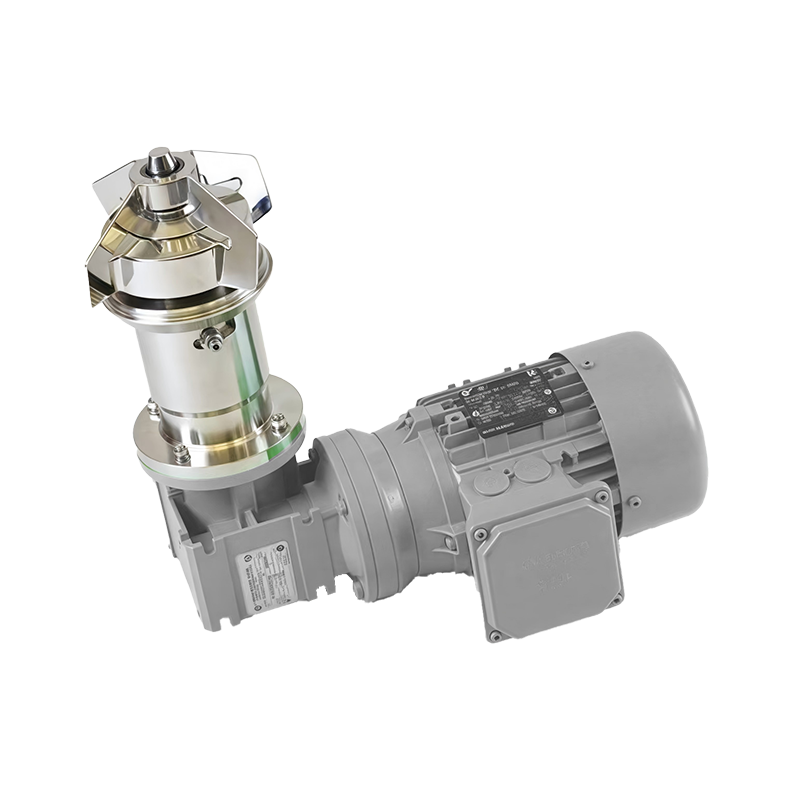
 Bottom-Mounted Magnetic Mixers for Pre-Mix and SuspensionDesigned for low-shear blending in bioprocessing and pharmaceutical lines, this mixer hydrates thickeners and prepares the continuous phase before emulsification. Its magnetic drive and CIP/SIP compatibility fit the hygienic context described.View Product →
Recommendation: Send a process specification, not a model number. Describe the emulsion recipe, the temperature curve, and the QC stability test. The supplier engineering team can then match rotor-stator geometry, tip speed, and motor frame to the target droplet size. To review your numbers against a real capacity chart, contact the Shiloc engineering team.
Frequently Asked Questions
What shear rate does a bottom-entry high-shear magnetic emulsifier achieve?
Nominal shear rates of 20,000 to 100,000 per second are achievable depending on rotor diameter, rotational speed, and gap width. For example, a rotor running at 30 m/s tip speed across a 0.5 mm gap generates 60,000 per second, enough to reduce oil droplets to the 1 to 10 micron range in most food and cosmetic emulsions.
Can this equipment handle high-viscosity products?
Continuous phase viscosities up to about 50,000 mPas and dispersed phase viscosities up to about 5,000 mPas are practical, provided the rotor inlet receives product at process temperature. Higher viscosities require a pre-mix or pump-assisted feed, and the drive power must be verified against the cold-start viscosity.
Can a bottom-entry magnetic emulsifier be cleaned and sterilized?
Yes. The static containment shell and polished internal surfaces allow CIP at up to 95 C, and designs for aseptic lines support SIP up to 140 C. The bottom-mounted geometry provides full drainability, so the product contact area has no crevice where cleaning solution can stagnate.
Bottom-entry machine or inline rotor-stator: which one is better?
Use a bottom-entry machine for batch processes in existing tanks that need a hygienic, seal-free installation with full drainability. Use an inline machine for continuous recirculation loops with very high throughput or when one tank handles multiple products. The two are often combined: an inline unit for final pass finishing and a bottom-entry unit for batch emulsification.
Final note: A documented specification with QC acceptance limits removes the largest single cause of selection errors in emulsifier projects. Confirm the droplet size test method with your QC team before the machine is built, and put the acceptance limit in the purchase order.
PREV:How to Evaluate UHT Sterilizer Suppliers for Dairy and Beverage Projects
NEXT:How Integrated Process Skids for Food Improve Production Efficiency and Hygienic Processing
NEXT:How Integrated Process Skids for Food Improve Production Efficiency and Hygienic Processing
Interested in cooperation or have questions?
Let'S Work Together Welcome Aboard!
-

haikexin@haikexin.com
+8613391278930
-
 +86-21-57560276
-
 No. 2819, Sihu Road,Fengxian District, Shanghai, China
Join Our Mailing List
Copyright © Shiloc (Shanghai) Industrial Trading Co., Ltd. All Rights Reserved.
Process Systems & Equipment For Food & Biopharma Manufacturers
