
 English
 русский
 Português
 Français


 Read More

Product Category
NEW Category
Contact us
Contact Us
We specialise in the research, development and manufacture of electrical wires and cables.
 +86-21-57560276
Bioprocess Skid Piping: Key Hygienic and Process Requirements for Biopharma
Content
- 1 What Defines Hygienic Bioprocess Skid Piping?
- 2 Material and Surface Finish Requirements
- 3 Piping Layout: Drainage, Dead-Legs, and Connections
- 4 Welding and Joint Integrity
- 5 CIP, SIP, and Verification
- 6 Frequently Asked Questions
- 6.1 What is the difference between hygienic skid piping and ordinary industrial piping?
- 6.2 Why do bioprocess skid specifications require surface roughness of Ra 0.5 micron or better?
- 6.3 What is the practical dead-leg limit for bioprocess skid piping?
- 6.4 Can a skid with sanitary clamp connections pass SIP?
During factory acceptance testing of a bioprocess skid, two dead-legs measured 3.8 pipe diameters and a low point in the CIP return line held close to 700 mL of rinse water. The fix cost two weeks of schedule and a full weld resurvey. Hygienic performance cannot be added after the layout is cut; it has to be engineered in before the first tube is welded.
This article covers the hygienic and process requirements that decide whether a skid will clean, sterilize, and validate as designed: material and surface finish, drainability, dead-leg control, weld quality, and CIP/SIP verification. For the broader build context, see this overview of modern bioprocess skid manufacturing.
What Defines Hygienic Bioprocess Skid Piping?
Hygienic bioprocess skid piping is a network of product-contact tubing, fittings, valves, and instruments engineered so that every wetted surface can be cleaned and sterilized in place without disassembly, while protecting the process stream from contamination.
Four constraints separate hygienic piping from ordinary welded stainless systems:
- Material: 316L stainless steel with documented low carbon content.
- Surface finish: polished and, on product contact, electro-polished to Ra 0.5 micron or better.
- Geometry: self-draining slopes and dead-legs held to two pipe diameters or less.
- Joining: full-penetration orbital welds and sanitary clamp fittings; threaded joints are rejected.
This is why the piping specification is inseparable from the skid builder's design responsibility: the frame, the tube routings, and the heat-transfer loops are engineered as one system.
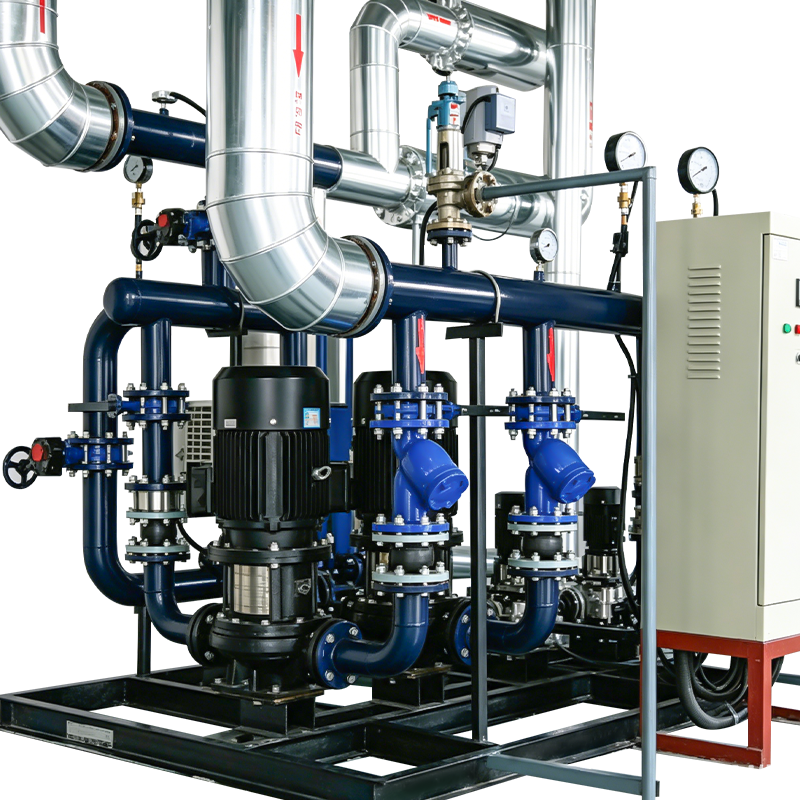
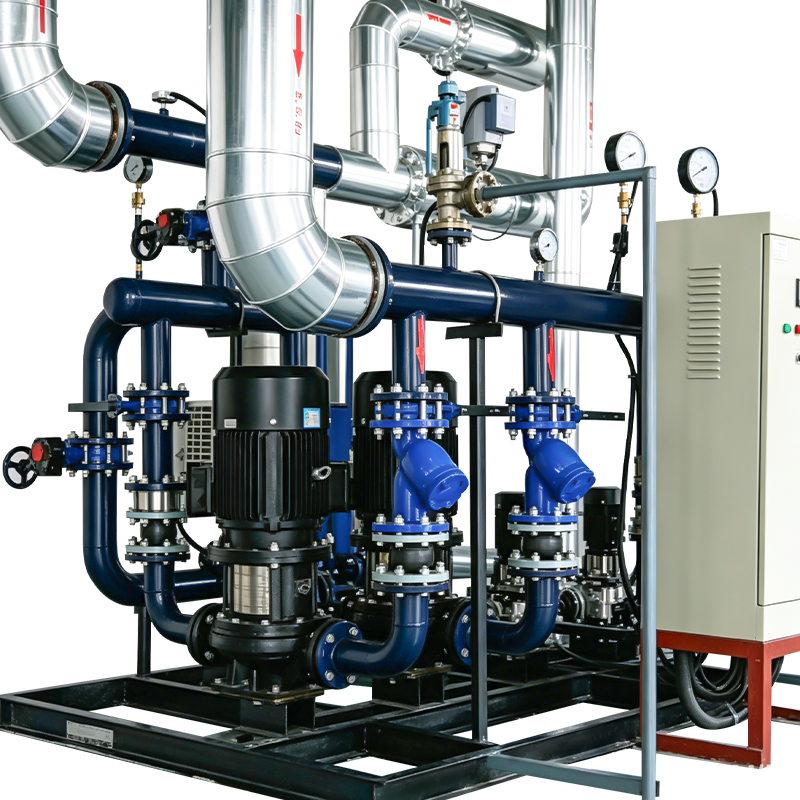 Intelligent Bioprocess Heat Transfer Skid with Integrated ControlThis skid-mounted unit combines plate heat exchangers, pumps, valves, and PLC control for centralized heating and cooling. It automatically regulates flow, supports status monitoring, and allows modular expansion, making it relevant for process heat exchange with minimal installation.View Product →
Design gate: every line on a skid is judged by one question - can cleaning solution reach every wetted surface and drain out completely without pooling?
Material and Surface Finish Requirements
The cleanability of skid piping is set by its material and surface finish, and the governing choice is 316L stainless steel (UNS S31603) with a maximum carbon content of 0.03 percent. That low carbon limit prevents chromium carbide precipitation at weld heat-affected zones, preserving the corrosion resistance that keeps the surface cleanable over years of service.
Mechanical polishing followed by electro-polishing removes the smeared, work-hardened layer left by tube manufacturing and forms a stable chromium-oxide film. Typical roughness classes are shown in the table below.
| Service classification | Target roughness | Finish method | Typical lines |
| Utility contact | Ra 0.6-0.8 micron | Mechanical polish | CIP feed, steam condensate |
| Product contact | Ra 0.5 micron | Mechanical plus electro-polish | Media, buffer, harvest lines |
| High-sensitivity contact | Ra 0.375 micron | Electro-polish | Cell culture, formulation lines |
0.03% Cmaximum carbon in 316L piping
Ra 0.5 micronproduct-contact roughness target
2 passespolish plus electro-polish on wetted surfaces
Ask the skid supplier for material test certificates and the surface finish verification plan. Suppliers of biopharmaceutical process equipment document both as a standard deliverable; if a supplier cannot, treat the skid as unproven.
Piping Layout: Drainage, Dead-Legs, and Connections
A layout is hygienic when every line drains completely by gravity, every branch is short enough to be swept by cleaning flow, and every joint is crevice-free. These geometry rules override piping convenience whenever the two conflict.
Four rules are applied on every qualified skid:
- Slope every horizontal line at least 1 percent; 1.2 percent is the common design target.
- Hold dead-legs to a length-to-diameter ratio (L/D) of 2 or less; on product-critical paths, design for L/D of 1.5 or zero.
- Tie branch lines into the top or side of the header so no liquid pocket forms when the line is idle.
- Use flush-diaphragm instruments and zero-dead-leg valve bodies instead of intrusive tee probes.
Where utility heat is applied with strict containment requirements, double-tube-sheet construction keeps the service and process circuits mechanically separate.
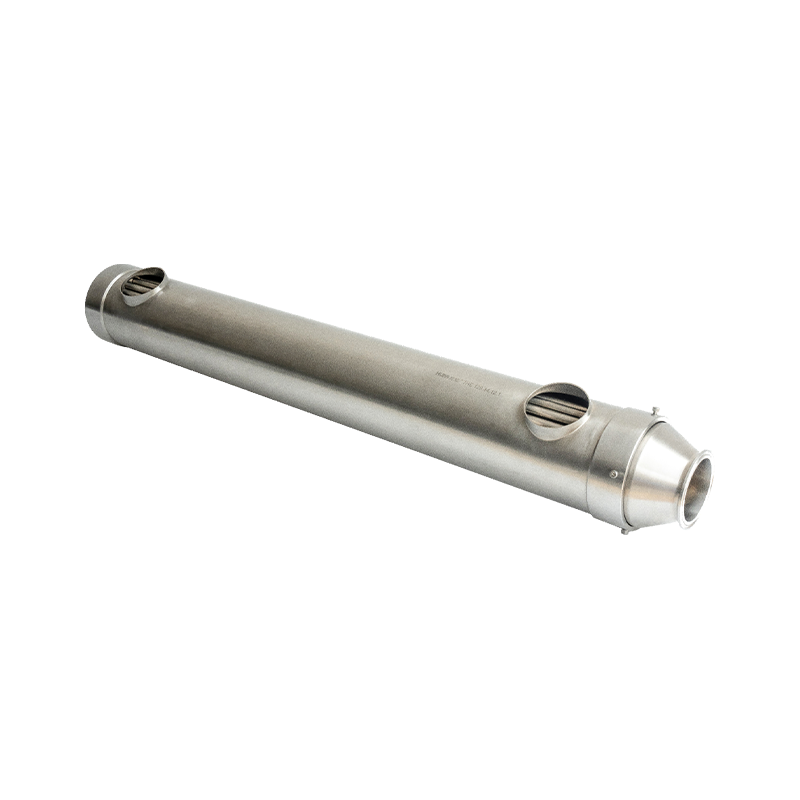
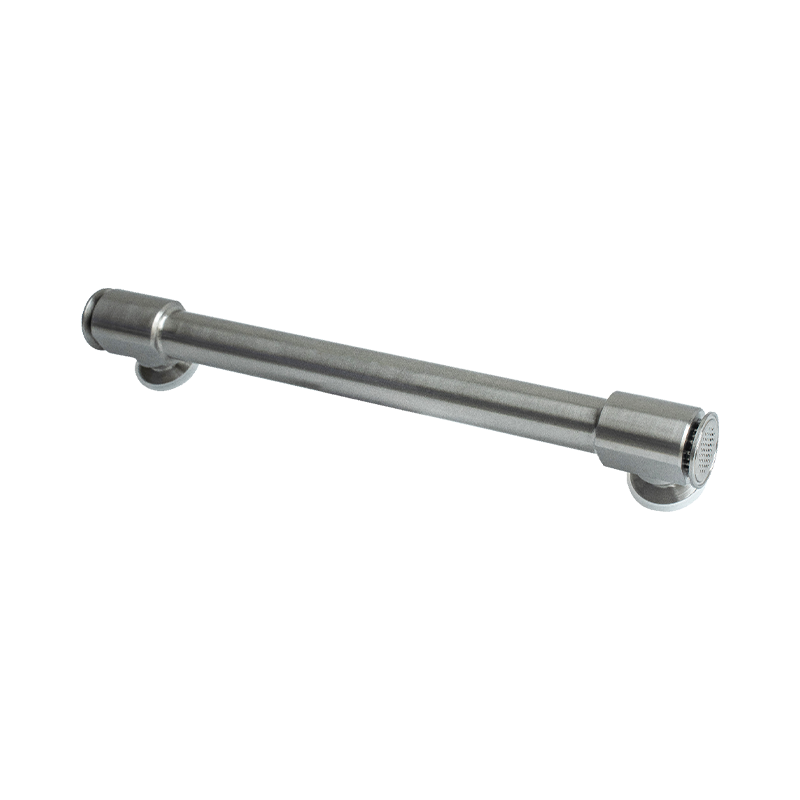 Sanitary Double Tube Sheet Heat Exchanger for Full DrainDesigned with double-tube-sheet safety and full-drain compliance, this heat exchanger prevents cross-contamination and meets FDA and CGMP standards. Its U-tube construction and customizable options align with hygienic and leak-detection needs in pharmaceutical processes.View Product →
| Design defect | Operational consequence |
| Dead-leg longer than 4 pipe diameters | Retains product and bioburden; fails rinse-recovery tests |
| Flat-bottomed valve cavity or capped tee | CIP impingement cannot reach; manual disassembly required |
| Low point in the SIP return line | Condensate pools; steam does not reach sterilizing temperature |
| Threaded instrument connection | Crevice supports microbial growth; not accepted on product lines |
Compliant layout: 1 percent slope, top-tied branches, short direct-mounted sensors, and full-bore diaphragm valves - rinse water exits within one drain cycle.
Non-compliant layout: center-tied instruments, bottom-mounted tees, and long capped branches - validated cleaning depends on manual intervention.
Welding and Joint Integrity
Weld quality decides whether an otherwise hygienic skid passes repeated SIP cycles and resists corrosion for its service life. The accepted practice is orbital TIG (GTAW) welding: automated heads, qualified weld procedures, and reproducible heat input on every joint.
Every product-contact weld is full-penetration and autogenous, back-purged with inert gas to prevent internal oxidation. Internal roughness must match the parent tube, and heat tint is limited to the light straw range; blue, gray, or black weld surfaces are rejected.
Fabrication rule: a weld that cannot be inspected has not been verified. Require borescope review, roughness sampling, and a weld log that maps heat numbers and welder qualifications to each joint.
The documentation package includes:
- WPS and PQR for each joint configuration used on the skid
- Welder certifications tied to actual weld numbers
- Weld map marked on the isometric drawing
- Passivation record, typically citric or nitric acid
CIP, SIP, and Verification
A skid is verified when its CIP and SIP cycles reproducibly return the piping to a clean, sterile state and the documentation proves it. CIP depends on turbulent flow and cleaning chemistry; SIP depends on saturated steam and complete air removal.
1.5-3 m/sCIP flow velocity at every branch
121-134 degCSIP steam temperature range
L/D 2dead-leg limit used in design
During CIP the piping must reach 1.5 to 3 meters per second at every branch, which is why dead-leg control and valve-port geometry are part of the hydraulic calculation, not decoration on the drawing. During SIP, every low point needs a working steam trap: a single trapped film of water leaves a cold spot below sterilizing temperature.
Temperature control for these cycles is normally delivered by a dedicated heating loop, often a precision temperature control unit holding utilities within the narrow band the cycle recipe requires.
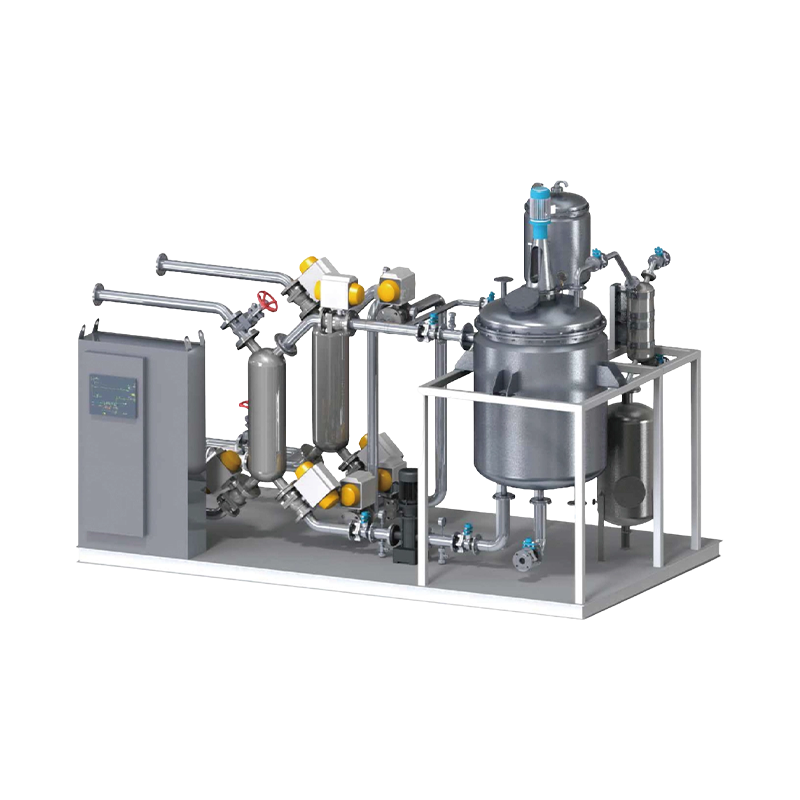 Precision Temperature Control Unit for Biopharmaceutical ProcessesThis closed-loop TCU provides precise heating and cooling with PLC-driven control, sanitary stainless steel contact parts, and dead-leg-free design. It supports multiple modes, data traceability, and adapts to bioreactor and reactor temperature requirements in regulated production.View Product →
Acceptance is built around four measurable endpoints:
- Rinse conductivity and pH back to feed-water baseline within the defined rinse volume
- Bioburden below the facility limit, typically under 10 CFU per 100 mL of rinse sample
- Endotoxin below the pharmacopoeial limit where depyrogenation is required
- Three consecutive cycles with no upward trend in residuals
Frequently Asked Questions
Direct answers to the questions most often raised during bioprocess skid piping reviews.
What is the difference between hygienic skid piping and ordinary industrial piping?
Industrial piping is sized for pressure, flow, and cost. Hygienic skid piping adds cleanability: surface finish limits, gravity drainage, dead-leg control, crevice-free joints, and hygienic valve and instrument designs that industrial installations rarely require.
Why do bioprocess skid specifications require surface roughness of Ra 0.5 micron or better?
Smoother surfaces retain fewer residues and clean faster because soil has less surface area to cling to. At Ra 0.5 micron with electro-polish, the passive chromium-oxide film is also more uniform and corrosion resistant across welded zones.
What is the practical dead-leg limit for bioprocess skid piping?
Industry practice, consistent with ASME BPE guidance, keeps dead-legs to a length-to-diameter ratio of 2 or less. Critical product lines are often built with L/D of 1 to 1.5, or with zero-dead-leg valve bodies, to make CIP reproducible.
Can a skid with sanitary clamp connections pass SIP?
Yes, when gasket materials are validated for repeated steam exposure and clamp torque is controlled. Welded permanent joints still reduce long-term failure modes, so most qualified skids combine orbital welds on permanent lines with clamps only at equipment interfaces.
Bioprocess skid piping rewards early decisions: define the surface finish target, dead-leg policy, and weld acceptance criteria before tube is ordered, and the skid will clean and sterilize as designed. Shiloc (Shanghai) Industrial Trading Co., Ltd. can support these specifications from design through factory acceptance testing.
PREV:No previous article
NEXT:Bottom-Mounted Magnetic Mixers: Key Mixing Performance and Hygienic Requirements
NEXT:Bottom-Mounted Magnetic Mixers: Key Mixing Performance and Hygienic Requirements
Interested in cooperation or have questions?
Recommended LINKS
✦
Process Skid System
Skid Mounted Process System
Food Processing Skid System
Sanitary Process Skid
CIP Skid System for Food Industry
Food and Beverage Process System
Aseptic Processing Equipment for Liquid Foods
UHT Processing Equipment for Plant Based Milk
UHT Processing System for Dairy Products
Milk Processing Heat Exchanger
Let'S Work Together Welcome Aboard!
-

haikexin@haikexin.com
+8613391278930
-
 +86-21-57560276
-
 No. 2819, Sihu Road,Fengxian District, Shanghai, China
Join Our Mailing List
Copyright © Shiloc (Shanghai) Industrial Trading Co., Ltd. All Rights Reserved.
Process Systems & Equipment For Food & Biopharma Manufacturers
