
 English
 русский
 Português
 Français


 Read More

Product Category
NEW Category
Contact us
Contact Us
We specialise in the research, development and manufacture of electrical wires and cables.
 +86-21-57560276
Bottom-Mounted Multi-Impeller Magnetic Mixers: Key Mixing and Process Control Factors
Content
An engineer specifying agitation for a 5,000 L buffer tank in a biopharmaceutical plant faces a familiar trade-off: top-entry agitators risk shaft-seal leakage over time, and side-entry units leave dead zones near the free surface. A bottom-mounted multi-impeller magnetic mixer removes the shaft seal entirely. Torque crosses the tank wall through a magnetic coupling, while two or more impellers on a submerged shaft keep fluid circulating from the tank bottom to the surface. That combination makes these mixers a preferred choice in sanitary food and biopharmaceutical processing. Specifying one correctly, however, means understanding the mixing and process control factors that determine whether a batch runs reliably or fails.
How Bottom-Mounted Multi-Impeller Magnetic Mixers Work
Bottom-mounted multi-impeller magnetic mixers transmit torque through a static containment shell via synchronized permanent magnets, driving two or more impellers inside a fully sealed tank with no dynamic shaft seal.
An outer magnet hub is coupled to the motor shaft beneath the tank. The inner magnet rotor, located on the wetted side of the containment shell, carries the impeller shaft. When the motor rotates, the magnetic field pulls the inner rotor into synchronous rotation, transferring torque without any rotating penetration of the vessel wall. Multiple impellers are stacked on the vertical shaft, typically with a pitched-blade impeller at the lowest position for axial suction and a second or third impeller above to sustain bulk circulation.
Core Definition
A magnetic coupling is a torque-transfer device in which synchronized permanent magnets on the drive side and the driven side rotate in phase across a thin static barrier, so no rotating shaft or mechanical seal penetrates the tank boundary.
Because the containment shell is a solid hygienic disc, the wetted side has no dynamic seal, no wear debris, and no potential leak path. The top of the tank remains free for manways, instrument ports, and CIP spray devices.
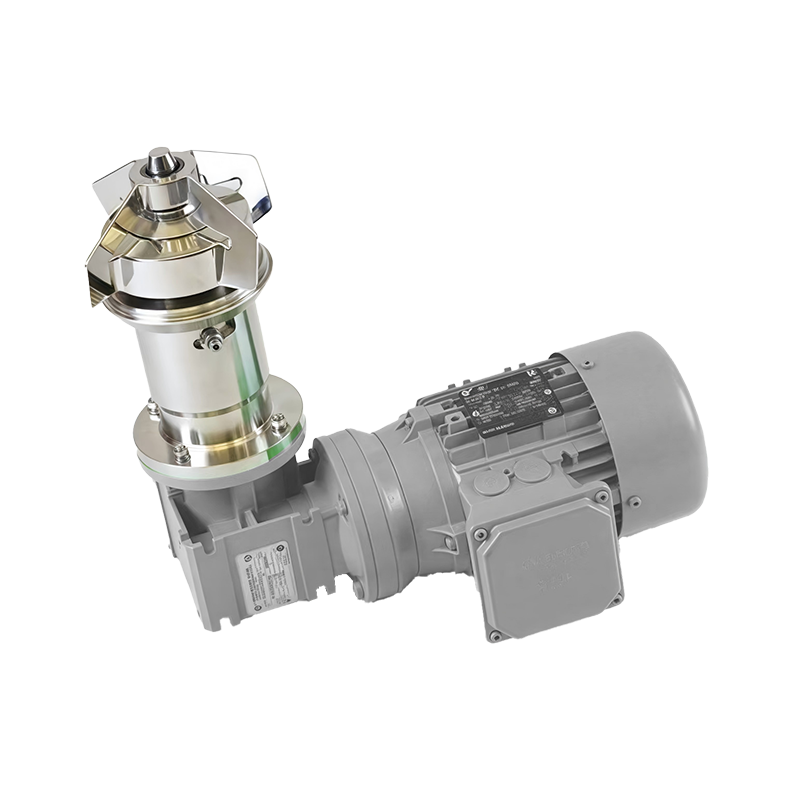
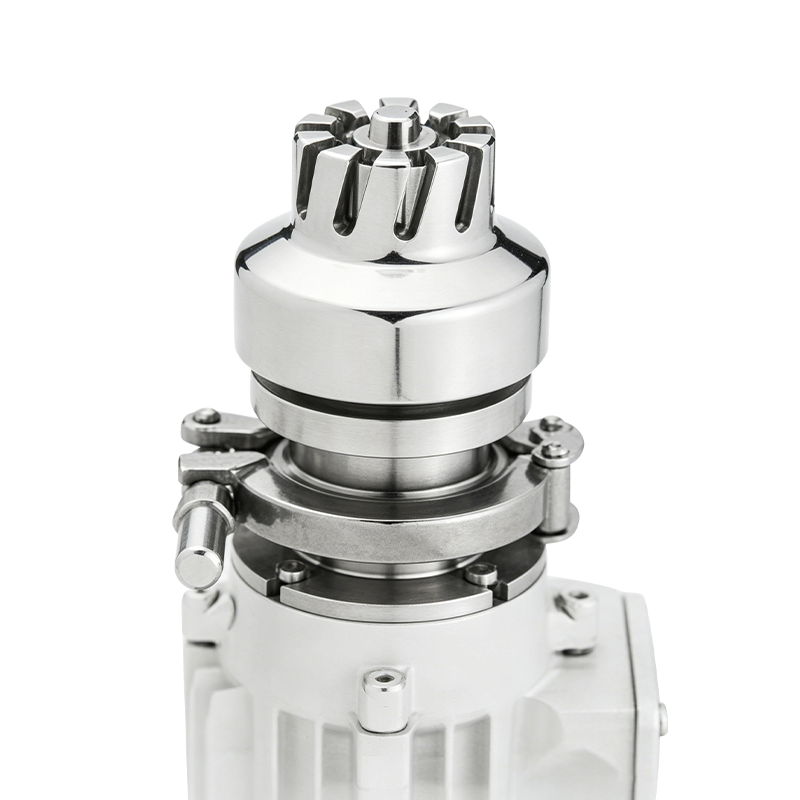
 Bottom-Mounted Magnetic Mixers with Single or Multiple ImpellersThis hygienic magnetic drive mixer features no dynamic seal on the wetted side, suitable for bioprocessing and pharmaceutical mixing with low shear, high efficiency, and CIP/SIP compliance.View Product →
Key Mixing Factors That Determine Performance
Impeller geometry, impeller spacing, rotational speed, and tank geometry determine whether a bottom-mounted multi-impeller magnetic mixer produces uniform dispersion or leaves stagnant zones that compromise the batch.
Impeller Geometry and Placement
Pitched-blade impellers generate axial flow, which is essential in tall tanks to move fluid from the bottom to the free surface. Hydrofoil impellers deliver the same axial flow with lower shear at equal power input. Radial-flow impellers create high shear near the impeller and are better suited to gas dispersion or fine emulsification. A common hygienic design combines a lower pitched-blade impeller that pulls product into the suction zone with an upper hydrofoil impeller that maintains circulation. Impeller spacing follows the practical rule of 1.0 to 1.5 impeller diameters between successive impellers, adjusted upward as viscosity increases.
Speed, Power Input, and Tank Geometry
Tip speed controls shear rate and is a critical limit for shear-sensitive products. Many biopharmaceutical processes hold tip speed between 2 and 5 m/s to avoid protein denaturation or emulsion instability. Power input per unit volume, expressed in watts per liter, is the standard scale-up parameter and typically ranges from 0.1 to 2.0 W/L depending on whether the duty is gentle blending or demanding suspension. The governing geometric constraint is the liquid height-to-diameter ratio. A single bottom impeller loses effectiveness above an H/D of roughly 1.5, while a two-impeller configuration extends the range to about 2.5 and a three-impeller train to about 3.5.
Typical design ranges for sanitary magnetic mixers
1.0-1.5 D Impeller spacing
2-5 m/s Tip speed range
0.1-2.0 W/L Power density
1.5-3.5 Practical H/D range
Process Control Factors in Sanitary Mixing
Process control for bottom-mounted magnetic mixers goes beyond rotational speed setpoints to include torque monitoring, temperature interlocks, and cleaning validation, because the mixer is the only wetted rotating element and it directly controls heat and mass transfer inside the vessel.
Torque Monitoring as a Process Probe
The magnetic coupling transmits measurable torque, so the drive can report load continuously. A sudden torque increase signals viscosity drift, particle settling, or fouling on the impeller. When the mixer is stopped, residual torque indicates product residue built up on the impeller hub. For batch reproducibility, torque data lets operators detect the moment a blending endpoint is reached; for maintenance, it identifies developing problems weeks before mechanical failure.
Cleaning and Sterilization Integration
Bottom-mounted mixers must tolerate repeated clean-in-place and sterilize-in-place cycles. The wetted surface must be crevice-free, polished to a hygienic finish, and self-draining. Impeller bottom clearance and hub geometry determine whether cleaning shadow zones form beneath the impeller. Most validated installations run a defined CIP sequence at elevated temperature and confirm cleanliness by rinse-water sampling or surface swabs.
Torque-to-process correlation is the central idea behind advanced mixing control. When torque is measured continuously, viscosity variation between batches becomes visible, and speed or blending time can be adjusted in real time instead of relying on fixed recipes.
The same control philosophy extends to entire process trains. See how automation in food pasteurization applies continuous monitoring to heat-treatment skids.
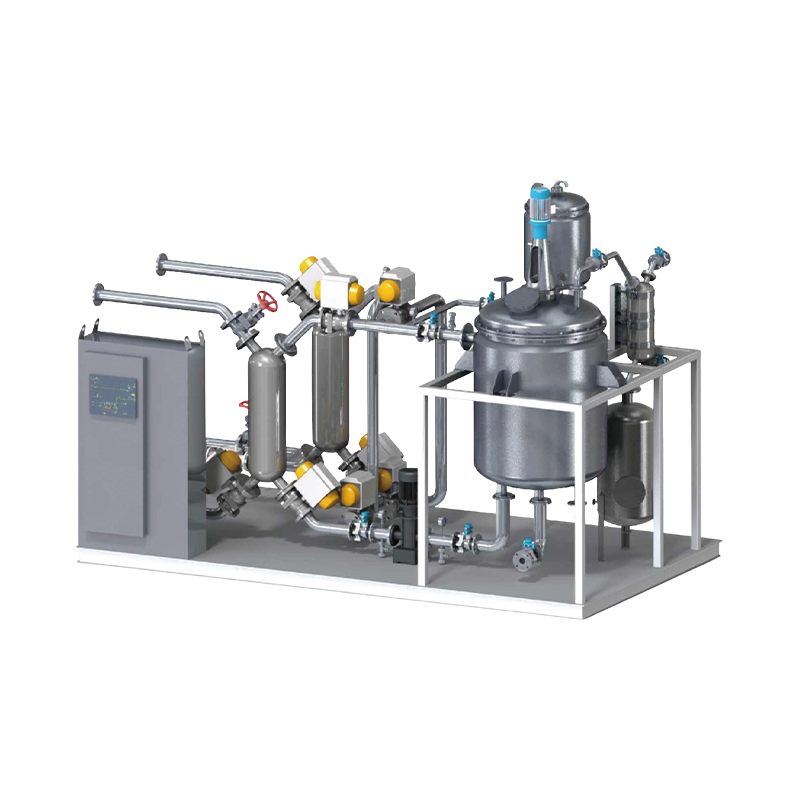
 Food-Grade CIP System for Automated Cleaning and DisinfectionAn online cleaning system for food pipelines and tanks, with PLC-controlled multi-step washing, traceable data, and modular tank configuration for dairy, beverage, and sauce production.View Product →
Single-Impeller versus Multi-Impeller Configurations
Multi-impeller configurations are the right choice when liquid height exceeds roughly 1.5 tank diameters, when product uniformity must be maintained across a tall liquid column, or when the process requires both bulk blending and localized high shear.
Maximum Practical H/D Ratio by Configuration
| Factor | Single Impeller | Multi-Impeller (2-3) |
| Max practical H/D ratio | 1.5 | 3.5 |
| Bulk flow in tall tanks | Stratification risk | Continuous axial circulation |
| Blend time at equal power | Baseline | 30-50% shorter |
| Solids suspension | Limited | Strong; keeps solids moving |
| Cleaning complexity | Simpler geometry | More wetted surface area |
| Power per unit of circulation | Higher | Lower and more efficient |
The trade-off is cleaning time and cost: more impellers mean more wetted surface and a longer CIP cycle. For simple low-viscosity duty in a short tank, a single impeller remains the economical choice.
Selecting a Bottom-Mounted Multi-Impeller Magnetic Mixer
Selection starts by defining the process goal, the fluid rheology, and the tank geometry, then verifying that the supplier can deliver material certificates, surface finish, and validation documentation for the intended sanitary class.
- Process goal - blending, solid suspension, emulsification, or heat-transfer enhancement.
- Fluid data - viscosity curve, density, solids concentration, shear sensitivity, and operating temperature.
- Tank constraints - H/D ratio, bottom shape, manway access, and CIP/SIP temperature limits.
- Supply chain - lead time, documentation language, spare parts, and after-sales service.
Shiloc (Shanghai) Industrial Trading Co., Ltd. supplies sanitary mixing and heat-transfer equipment for food, beverage, and biopharmaceutical production. Pairing a bottom-mounted mixer with a precision temperature control unit keeps product temperature stable while the impeller circulates, which improves consistency in processes such as CIP heating, media preparation, or crystallization.
Mapping your tank configuration against our process application engineering experience is the fastest route to a reliable specification.
 Precision Temperature Control Unit for Food and Beverage ProcessesClosed-loop TCU for reactors and mixing tanks offering heating, cooling, and switching modes with food-grade stainless steel construction, PLC control, and data recording for process stability.View Product →
Frequently Asked Questions
Can a bottom-mounted multi-impeller magnetic mixer handle high-viscosity fluids?
Yes, up to roughly 5,000 to 20,000 cP (centipoise) apparent viscosity, depending on impeller diameter and magnetic coupling torque. High-viscosity duty requires larger-diameter hydrofoil impellers and a coupling sized for worst-case cold-start torque.
How is a bottom-mounted magnetic mixer cleaned in place?
Drain the tank, introduce the CIP solution at the specified temperature and flow rate, and run the mixer at low speed during rinsing so the cleaning fluid reaches every impeller surface. SIP with pure steam is feasible when the mixer design, gasket materials, and surface finish are specified for steam exposure.
What tank height-to-diameter ratio can a multi-impeller bottom-mounted mixer cover?
With two impellers, an H/D up to about 2.5 is practical. With three, up to about 3.5. Verify that the lowest impeller generates enough axial flow to prevent dead zones at the tank bottom.
Does torque monitoring improve process control in practice?
Yes. Torque is the most reliable non-invasive real-time signal of mixing load. Combined with temperature and pH sensors, torque data reveals viscosity drift, particle settling, and impeller fouling, allowing early corrective action before the batch is lost.
PREV:How Integrated Process Skids for Food Improve Production Efficiency and Hygienic Processing
NEXT:CIP System for Food Processing: Key Cleaning Flow and Temperature Requirements
NEXT:CIP System for Food Processing: Key Cleaning Flow and Temperature Requirements
Interested in cooperation or have questions?
Recommended LINKS
✦
Process Skid System
Skid Mounted Process System
Food and Beverage Process System
Food Processing Skid System
Aseptic Processing Equipment for Liquid Foods
Aseptic Beverage Processing Line
Aseptic Milk Processing Equipment
UHT Processing Equipment for Plant Based Milk
UHT Processing System for Dairy Products
Milk Processing Heat Exchanger
Let'S Work Together Welcome Aboard!
-

haikexin@haikexin.com
+8613391278930
-
 +86-21-57560276
-
 No. 2819, Sihu Road,Fengxian District, Shanghai, China
Join Our Mailing List
Copyright © Shiloc (Shanghai) Industrial Trading Co., Ltd. All Rights Reserved.
Process Systems & Equipment For Food & Biopharma Manufacturers
