
 English
 русский
 Português
 Français


 Read More

Product Category
NEW Category
Contact us
Contact Us
We specialise in the research, development and manufacture of electrical wires and cables.
 +86-21-57560276
Direct Contact Heat Exchanger: Key Heating and Mixing Requirements in Process
Content
- 1 What a Direct Contact Heat Exchanger Actually Is
- 2 Heating Requirements: The Steam Side Sets the Duty First
- 3 Mixing Requirements: Interfacial Area Comes Before Surface Area
- 4 Direct Contact Versus Wall-Based Units: Where Each One Trades
- 5 What to Write Into a Direct Contact Specification
- 6 Answers to the Questions Process Engineers Ask Most
A dairy line moving 20,000 litres per hour has to lift raw milk from 5 °C to 72 °C and hold it there for 15 seconds. Bolt a plate heat exchanger onto that duty and the stainless wall between product and hot water becomes the bottleneck: it fouls, it adds 1 to 3 K of approach temperature, and it must be opened for cleaning. Replace it with a steam injector and the wall disappears, because the steam condenses inside the product. The engineering problem shifts from surface area to mixing.
Direct contact heat exchange is not a laboratory curiosity. It runs in UHT lines, seawater desalination plants, geothermal brine loops and gas-solid dryers. Whether it works on a given duty comes down to three process numbers: the quality of the steam entering the contactor, the size of the bubbles or droplets formed at the mixing point, and the contact time the product can tolerate before quality suffers.
0.5-1.0 K Approach temperature reached in direct condensation, against 5-10 K for shell-and-tube units
0.1-2 s Typical mixing and residence time at an in-line steam injection point
1 % vol Non-condensable gas in steam that can cut condensing capacity by roughly half
What a Direct Contact Heat Exchanger Actually Is
A direct contact heat exchanger transfers heat through the interface between two streams rather than through a metal wall. Steam injected into milk, flue gas sparged through water, and air blown through a falling bed of granules are all direct contact duties, and every one of them depends on mixing quality rather than on tube surface condition.
Definition
A direct contact heat exchanger is a device in which two immiscible streams at different temperatures exchange heat through their own interface, with no separating wall. The transferred duty depends on interfacial area, contact time and the driving temperature difference, not on the thermal resistance of a tube wall.
Three families cover almost all industrial duty: gas-liquid contactors, where one phase is dispersed as bubbles or droplets; liquid-liquid contactors, where two immiscible liquids are mixed and then separated; and gas-solid contactors, where a gas stream heats or cools a moving bed of particles. Each family has its own mixing regime, and each one fails in a different way when that regime breaks down.
| Contactor type | Phase pair | Typical duty | Contact time |
| Steam injector or ejector | Steam and liquid | UHT and HTST heating, water heating | 0.1-2 s |
| Spray condenser | Vapour and liquid droplets | Vapour condensation, process water heating | 1-5 s |
| Sparged or bubble column | Gas and liquid | Heating, cooling, humidification, stripping | 10-60 s |
| Liquid-liquid contactor with settling zone | Two immiscible liquids | Geothermal brine, desalination, waste heat recovery | 5-30 s |
| Rotary gas-solid contactor | Gas and bulk solids | Drying and cooling of powders and granules | 20-120 s |
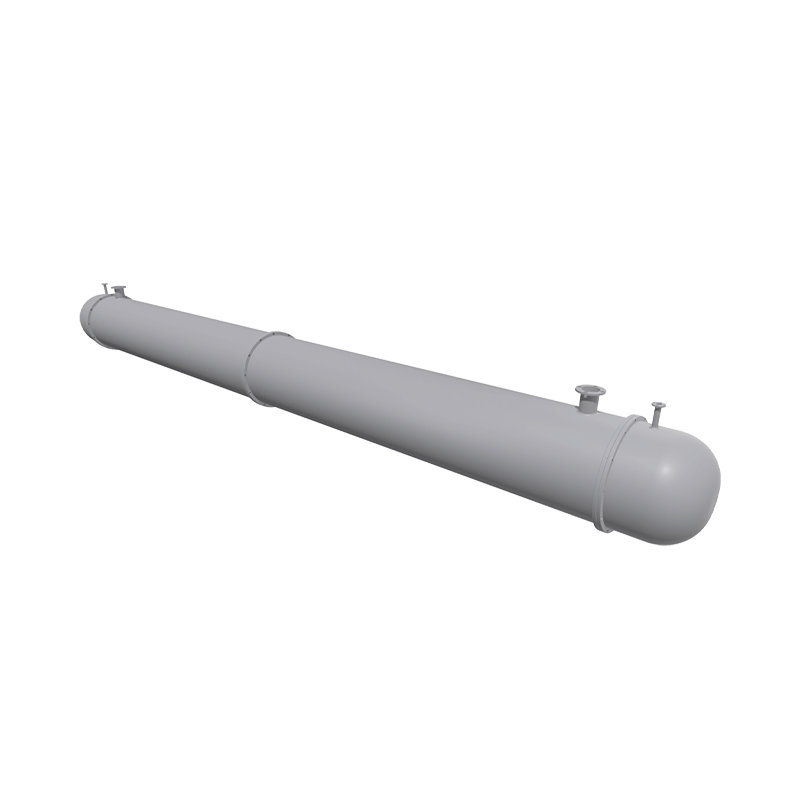
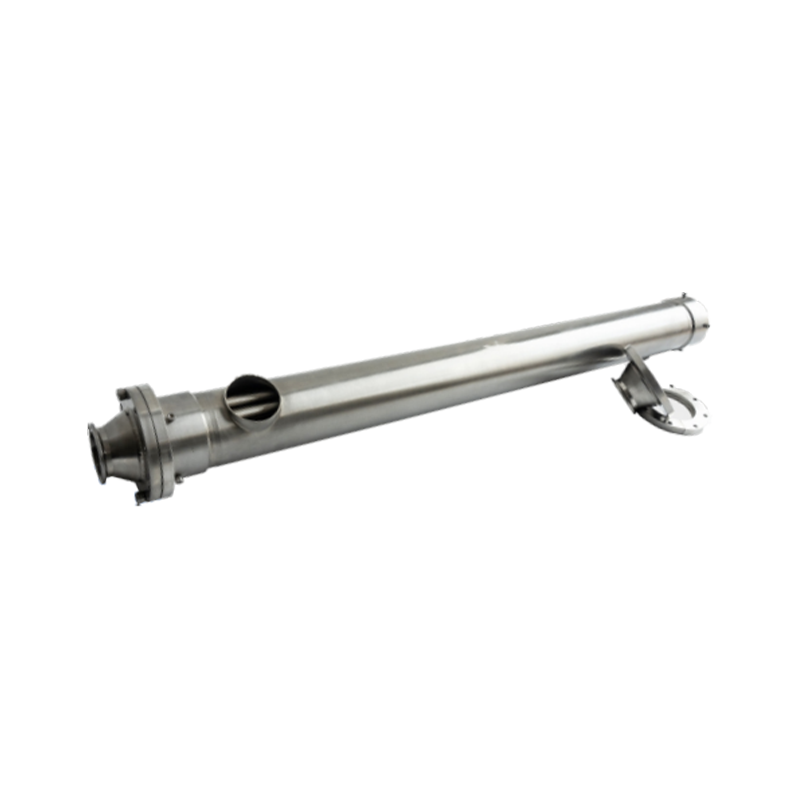
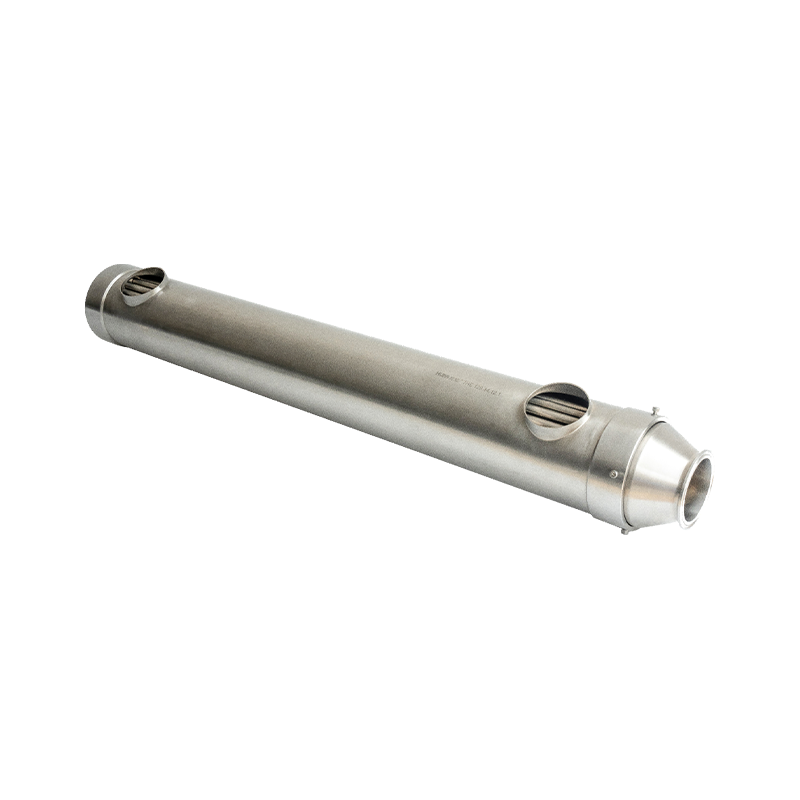
Because the interface is the heat transfer surface, a direct contact unit can be built inside a single hygienic housing. A hybrid direct contact heat exchanger engineered for food duty, for example, places the injection stage and the separation stage in one vessel, which removes the intermediate hot water loop and its circulation pumps entirely.
 Hybrid Direct Contact Heat Exchanger for Food DutyA single-vessel hygienic exchanger that mixes steam and process media directly, removing intermediate hot-water loops and reducing tube-wall fouling.View Product →
The trade-off is that the two streams must physically meet. That single fact drives every specification decision that follows, from steam filtration to the size of the settling zone.
Heating Requirements: The Steam Side Sets the Duty First
Heating duty in a direct contact unit is fixed by a mass and energy balance, not by surface area. Raising one kilogram of a milk-like product by 60 K at 3 bar(a) steam consumes roughly 0.11 to 0.12 kg of steam, and that figure does not change when the contactor is enlarged.
Steam quality and non-condensable gas
Two steam-side parameters decide whether the calculated duty is achievable in practice, and both are checked before any thermal design is frozen.
- Dryness fraction of 0.95 or higher. Wet steam carries entrained boiler water droplets that add dissolved solids to the product and erode the injection nozzle.
- Non-condensable gas below 1% by volume. Air or nitrogen reaching the condensing interface blankets it, and venting is the only cure once the gas is present.
- Filtration and steam grade. Food and beverage duty normally references the 3-A accepted practice for culinary steam, while biopharma duty references USP purified or pure steam limits.
Temperature targets and the dilution they create
Standard thermal targets carry over unchanged. HTST pasteurisation holds product at 72 °C for 15 seconds, and UHT treatment runs at 135 °C to 150 °C for 2 to 5 seconds. What changes with direct injection is that the condensed steam adds water to the product, at roughly 11% by mass on a 60 K rise.
Process note
The added water is designed out, not lived with. In a direct UHT system the product is injected to about 140 °C, held for 2 to 5 seconds, then flashed into a vacuum vessel at roughly 70 °C. Flash evaporation removes exactly the water the steam contributed, so the final solids content returns to its original value.
Steam injection and ejector units are the workhorses of this duty because they combine the heating step and the first mixing step in a single nozzle assembly.
 Sanitary Steam Ejector for Inline Heating and MixingA hygienic Venturi injector that uses steam to heat, mix, and convey liquid or gaseous media inline, with no moving parts.View Product →
Where flash cooling is impossible, because the product is too viscous to release vapour or too heat-sensitive to enter a vacuum chamber, the direct route stops and a wall-based exchanger remains the safer choice.
Mixing Requirements: Interfacial Area Comes Before Surface Area
In a direct contact device the heat transfer surface is the interfacial area, approximately six times the dispersed-phase volume fraction divided by the Sauter mean diameter. Halving the mean droplet or bubble diameter doubles the available area without touching the vessel, which is why mixing energy matters more than vessel volume.
Droplet and bubble sizing
Sparged and bubble-column contactors typically produce Sauter mean diameters between 0.5 mm and 3 mm. In-line steam injectors and ejectors reach 0.1 mm to 1 mm, driven by a pressure drop of roughly 1 to 4 bar across the nozzle. That order-of-magnitude gap is what separates a 30-second contactor from a 1-second one.
Mixing time and local overheating
Mixing time at the injection point should be held between 0.1 and 2 seconds. Longer contact inside the injection plume means the product closest to the nozzle spends measurable time well above the bulk target temperature, and dairy proteins denature at that local hot spot even when the average outlet temperature reads correctly.
Separation, the requirement that ends most projects
Dispersed-phase hold-up sits between 5% and 20% by volume in liquid-liquid contactors, and the settling zone must be sized from Stokes' law for the smallest droplet that will not be carried out with the continuous phase. If the two streams cannot be separated completely, direct contact is the wrong technology no matter how attractive the heat transfer looks on paper.
Doubling mixing energy to halve the average droplet diameter buys 100% more interfacial area and no additional heat transfer surface.
Five decisions that fix the design
- Fix the duty and the target temperature. A 60 K rise needs 0.11 to 0.12 kg of steam per kilogram of product, and the outlet tolerance is normally held at plus or minus 0.5 K.
- Set the steam specification. Dryness fraction of 0.95 or better, non-condensable gas under 1%, and filtration matched to the culinary or pure steam grade.
- Size the interface. Choose the nozzle or sparger that delivers the target Sauter mean diameter at the available pressure drop.
- Set the contact time budget. Injection and mixing in 0.1 to 2 seconds, hold tube residence in 2 to 5 seconds for UHT duty.
- Prove separation and control. Model the settling or flash stage, then confirm vacuum, level and temperature control within the stated tolerance.
Direct Contact Versus Wall-Based Units: Where Each One Trades
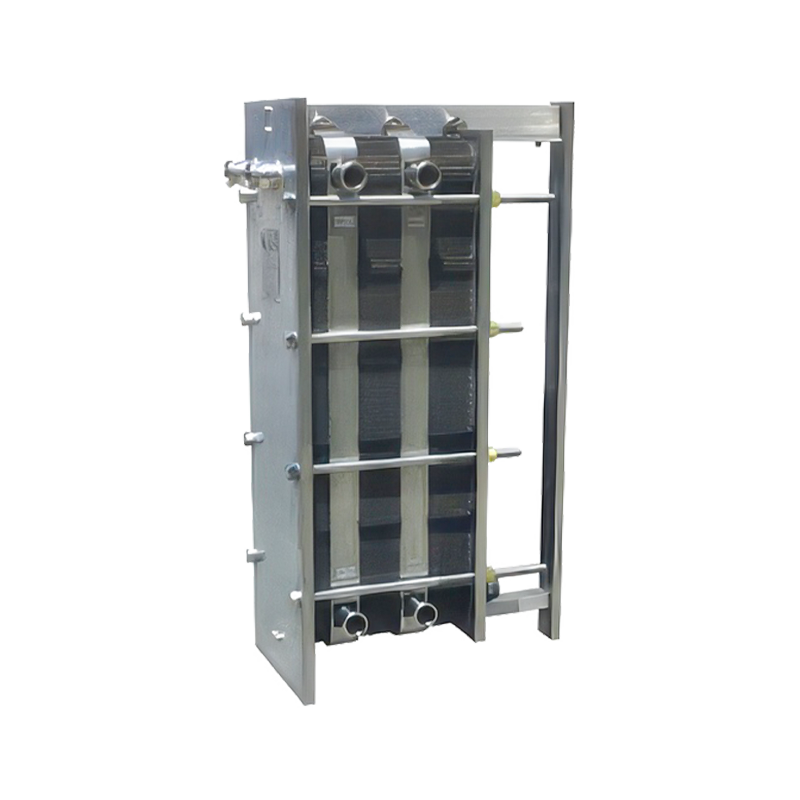
Direct contact designs reach approach temperatures of 0.5 K to 1 K, against 1 K to 3 K for plate units and 5 K to 10 K for shell-and-tube units, but they qualify only when the two streams can be separated afterwards.
Direct contact
- Approach temperature of 0.5 K to 1 K in condensing duty
- No wall, so no fouling layer and no scaling surface
- Lowest installed cost for direct heating and vapour condensation
- Requires proven separation of the two streams
Wall-based
- Approach temperature of 1 K to 10 K depending on type
- No cross-contact between product and service fluid
- Works with any two fluids that must stay apart
- The wall itself fouls and needs periodic cleaning
Typical approach temperature by exchanger type (K)
Where direct contact wins decisively is continuous sterilisation. An automatic UHT ultra-high-temperature sterilizer built around direct injection reaches 140 °C in under two seconds and returns to 70 °C in the flash vessel, a heat-up and cool-down profile that a wall-based unit cannot match without far more surface.
 Automatic UHT Sterilizer for Liquid Food ProcessingA direct-injection flash sterilization system with automated control, rapid heating and cooling, and high heat recovery for dairy and beverages.View Product →
The same logic applies to waste heat recovery from geothermal brine and to bulk solids cooling, where the solids themselves are the dispersed phase and no separation step is needed at all.
What to Write Into a Direct Contact Specification
A complete direct contact specification contains six numbers: duty in kW, product flow in kg/h, steam pressure and dryness fraction, target temperature with its tolerance, maximum permitted residence time, and the allowable dilution by mass.
- Duty and product flow, stated at the design viscosity and not at water properties.
- Steam pressure, dryness fraction of 0.95 or better, and the filtration grade.
- Target temperature with tolerance, typically plus or minus 0.5 K on the outlet.
- Maximum residence time at temperature, normally 2 to 5 seconds for UHT duty.
- Allowable dilution, expressed as a percentage of product mass and verified against the flash or separation stage.
- Product-contact surface finish and hygienic criteria, including a roughness value of 0.8 micrometres Ra or better for dairy and biopharma duty.
Purchasing risk
Most direct contact projects that underperform on site fail on the steam side, not the vessel side. A dryness fraction of 0.90 instead of 0.95 changes both the energy balance and the product composition, and it is normally discovered three weeks after commissioning rather than at the design stage.
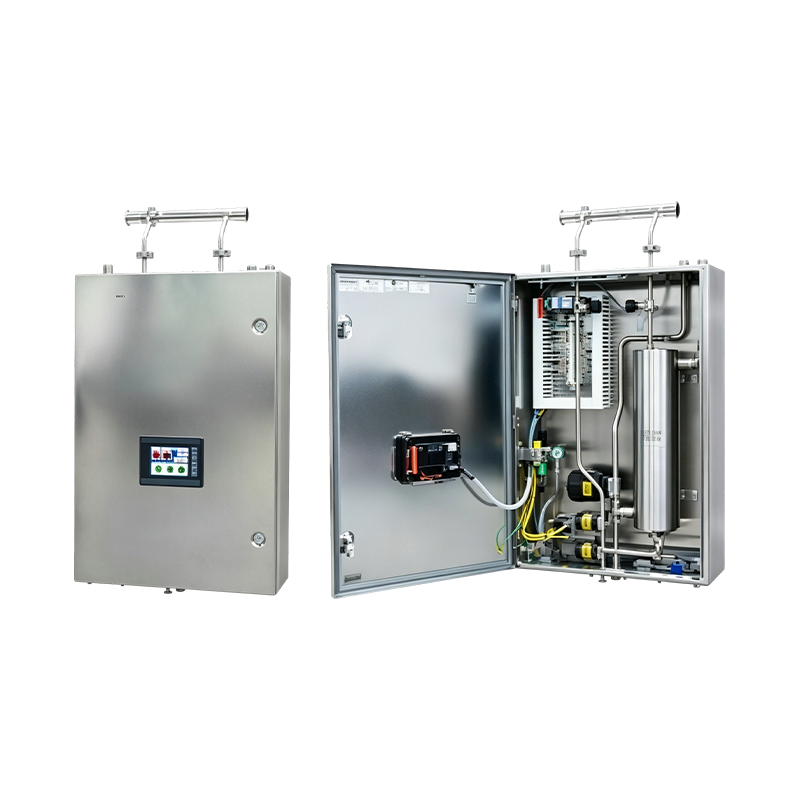
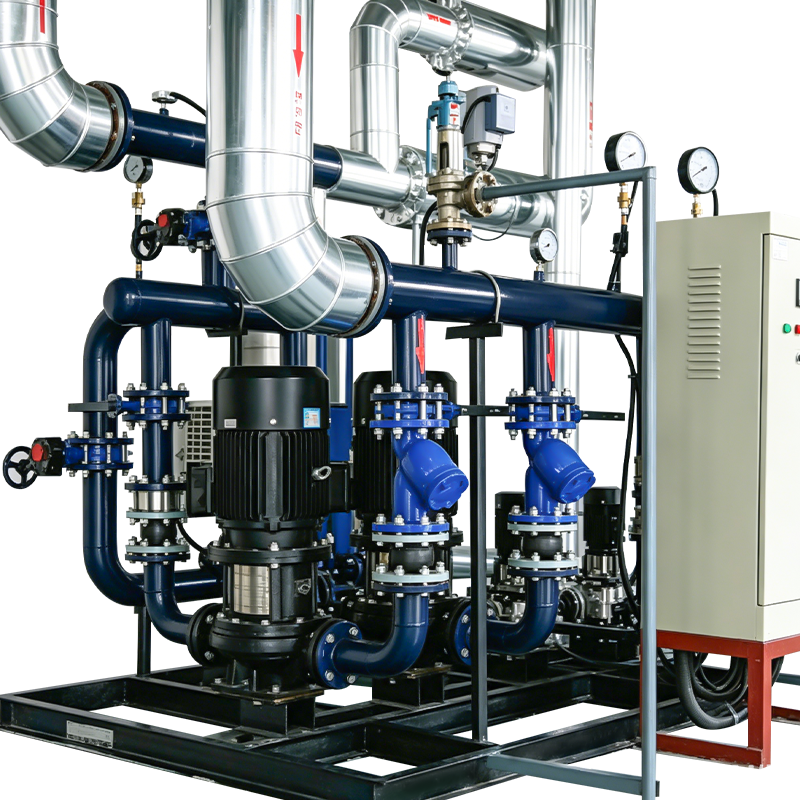
Surface finish, material grade and joint geometry follow the same rules as any product-contact part; the practical requirements are set out in our note on material and surface finish for hygienic heat exchangers. When the contactor ships as part of a larger package, the surrounding pipework, valves and instrumentation usually arrive as an integrated sanitary process skid, which keeps the hygienic boundary in one place.
Shiloc (Shanghai) Industrial Trading Co., Ltd. supplies these units into food, beverage and biopharma projects, where the specification is normally reviewed by a process engineer, a quality function and a purchasing team before the nozzle size is fixed.
Answers to the Questions Process Engineers Ask Most
How much water does direct steam injection add to the product?
About 0.11 kg of condensate per kilogram of product for a 60 K rise, which is close to 11% by mass. In direct UHT duty that water is removed again by flash evaporation at roughly 70 °C, so the final solids content is unchanged; if flash cooling is not possible, the dilution must be accepted or the direct route abandoned.
What steam quality is required for food and biopharma duty?
Dryness fraction of 0.95 or higher, non-condensable gas below 1% by volume, and filtration matched to the application. Food and beverage installations normally reference the 3-A accepted practice for culinary steam, while biopharma installations work to USP purified or pure steam limits with 316L stainless steel contact surfaces.
Can a direct contact unit handle fouling or viscous products?
Yes. With no wall there is no surface on which starch, protein or mineral scale can deposit, which is why direct injection is used on whey, starch and high-solids streams where wall units foul within hours. The limits are mixing energy and separation: above roughly 500 cP, mixing time rises sharply and the required nozzle pressure drop becomes uneconomic.
What is the lowest approach temperature achievable?
Between 0.5 K and 1 K in condensation duty, limited by non-condensable gas in the steam and by the residence time needed for complete phase separation. Pushing below 0.5 K adds contactor volume with sharply diminishing returns, and removing the last traces of air from the steam is normally the cheaper fix.
Rule of thumb
If the steam is dry, the droplets are small and the two streams separate cleanly, a direct contact exchanger will beat a wall-based unit on approach temperature, capital cost and cleaning downtime. If any one of those three conditions fails, it will not.
PREV:Tube In Tube Heat Exchanger: Thermal Performance and Process Requirements
NEXT:Biopharma Process Heat Transfer Units: Key Material and Hygienic Requirements
NEXT:Biopharma Process Heat Transfer Units: Key Material and Hygienic Requirements
Interested in cooperation or have questions?
Recommended LINS
✦
Process Skid System
Food and Beverage Process System
UHT Processing System for Dairy Products
Food Processing Skid System
UHT Processing Equipment for Plant Based Milk
automated process skid system for food processing
milk processing skid system
liquid food processing skid system
juice processing skid system
CIP cleaning skid system
Let'S Work Together Welcome Aboard!
-

haikexin@haikexin.com
+8613391278930
-
 +86-21-57560276
-
 No. 2819, Sihu Road,Fengxian District, Shanghai, China
Join Our Mailing List
Copyright © Shiloc (Shanghai) Industrial Trading Co., Ltd. All Rights Reserved.
Process Systems & Equipment For Food & Biopharma Manufacturers
