
 English
 русский
 Português
 Français

 Read More

Product Category
NEW Category
Contact us
Contact Us
We specialise in the research, development and manufacture of electrical wires and cables.
 +86-21-57560276
Bioprocess Skid Performance: Key Factors That Decide Yield, Quality, and Uptime
Content
Bioprocess skids can fail quietly. A unit passes factory acceptance testing with stable temperature profiles, clean pressure readings, and no visible leaks. Six weeks after installation, the harvest titer drifts batch to batch, pressure drop across the heat exchanger climbs after every run, and cleaning validation returns borderline rinse results. The alarms never fire. The problems only appear when process engineers compare the trends against batch history.
Bioprocess skid performance really means three things: holding critical process parameters inside the ranges defined in the batch record, reproducing those ranges from batch to batch, and surviving repeated cleaning and sterilization cycles without degradation. Each of those depends on process variables, thermal and hydraulic design, control architecture, and operational practice. This article explains the factors that matter most and where they become visible in production.
The Process Parameters That Pressure-Test a Skid
Temperature is the first thing anyone checks, and for good reason. Cells respond to both the absolute value and the rate of change. If a thermal unit overshoots by 2–3 °C at a 37 °C setpoint, the deviation may not trigger an alarm, but it can shift metabolism, change protein glycosylation, or accelerate proteolysis. The time the product spends outside the acceptable band matters more than the peak value. Skids that control temperature tightly use low thermal mass in the utility loop, fast-stroking valves, and sensors mounted close to the process. For this reason, a precision temperature control unit for biopharma applications should be specified together with the vessel, agitator, and transfer lines, not acquired as an isolated box.
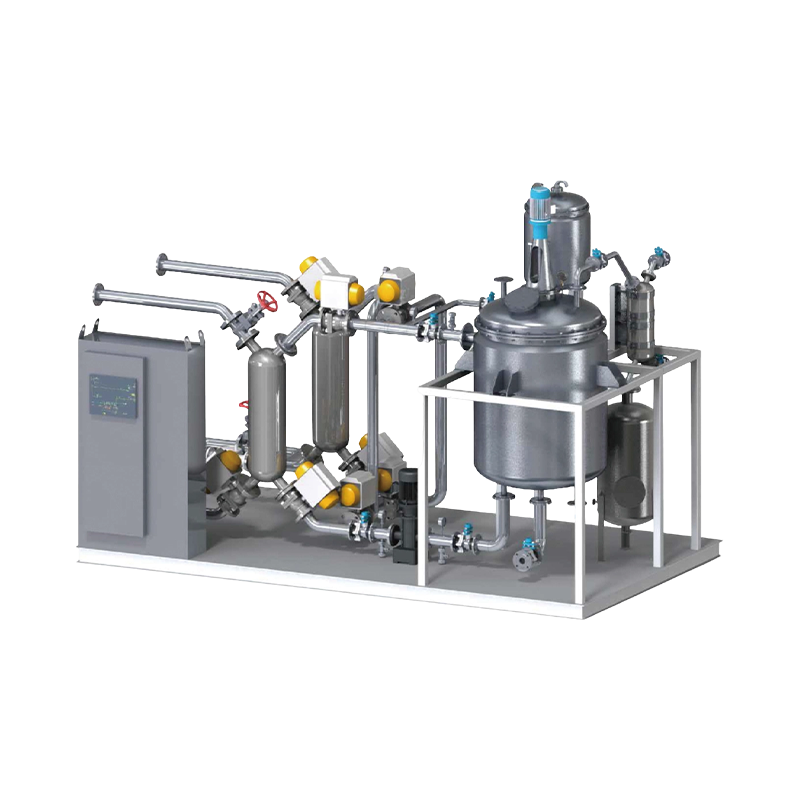 Custom Precision Temperature Control Unit (TCU) For Biopharma Manufacturers, FacShiloc (Shanghai) Industrial Trading Co., Ltd. Is China Custom Precision Temperature Control Unit (TCU) For Biopharma Manufacturers, Fact...View Product →
pH, dissolved oxygen, and backpressure are less obvious but just as decisive. pH control depends on dosing accuracy, mixing quality, and sensor reliability; acid or base addition through a peristaltic pump introduces a non-linear response that causes oscillation if the control curve is poorly matched. Dissolved oxygen changes as cell density climbs, so sparge and agitation loops must react without over-aerating or creating shear damage. In perfusion and filtration steps, fluctuating backpressure can damage cell-retention membranes or blind filters. The table below lists the parameters that most often expose skid weaknesses.
| Parameter | Typical control band | Consequence when uncontrolled |
|---|---|---|
| Temperature | ±0.5 °C or tighter at setpoint | Product degradation, batch-to-batch variability |
| pH | ±0.1–0.2 pH units | Metabolic shift, reduced titer |
| Dissolved oxygen | ±5–10% of setpoint | Oxygen limitation, altered metabolism |
| Backpressure | ±1–2 psi, step dependent | Membrane fouling, cell damage |
| Process flow rate | ±2–5% of setpoint | Residence time variation, uneven heat treatment |
Substrate and nutrient concentration completes the classic set. When the skid integrates feed pumps and weighing cells, feed accuracy becomes a performance factor in exactly the same way as acid or base dosing. These variables are not independent. A change in flow alters residence time and pressure drop; a change in temperature changes viscosity, which changes mixing and mass transfer. Skid performance problems are usually interactions between variables, not single-component failures, which is why the design must be reviewed as a system.
Thermal and Hydraulic Design: What Software Cannot Fix
The control system is only as good as the hardware it actuates. A skid with an undersized heat exchanger must use a larger temperature difference to transfer the required heat, pushing the utility loop toward its low-temperature limit. When the heat load rises unexpectedly, as it does when cell density climbs late in a run, the remaining margin is gone and the temperature profile drifts upward.
Turndown is just as critical. A pump sized for nominal flow may work well at 100% load but cannot hold stable flow at 20%. A control valve oversized for the line spends most of its life nearly closed, where a small stem movement causes a large flow change. Every component, from pump curve to valve characteristic to heat-transfer area, defines the operating window the control algorithm can actually reach. Integrated modules such as intelligent bioprocess heat transfer skid units treat this matching as a design requirement, which is why they behave predictably across a wider operating range than assemblies of individually selected parts.
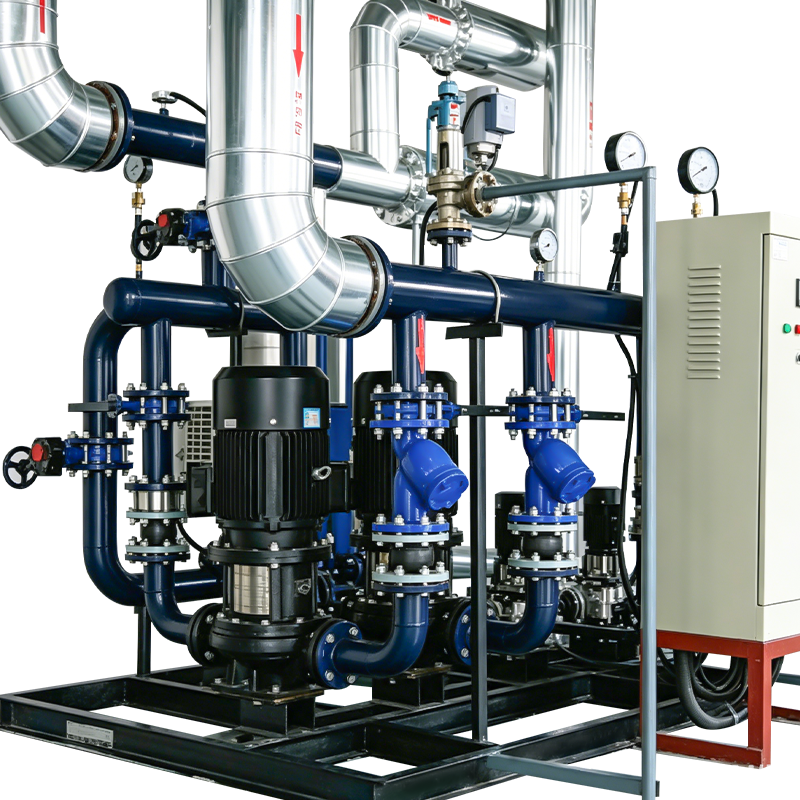 Custom Intelligent Bioprocess Heat Transfer Skid/Units Manufacturers, FactoryShiloc (Shanghai) Industrial Trading Co., Ltd. Is China Custom Intelligent Bioprocess Heat Transfer Skid/Units Manufacturers, Factory, Th...View Product →
Hydraulic layout matters even when components are correctly sized. Dead legs hold product and cleaning solution, creating reservoirs for microbial growth and residuals that survive the CIP cycle. Piping that cannot drain fully forces operators to rely on air blow-through. Weld quality, surface finish, slope, and valve arrangement determine whether a skid can be cleaned at the velocities the CIP design assumes. Materials add another layer: gaskets, diaphragms, and seals must survive the culture medium, cleaning chemicals, and repeated steam exposure. These are the decisions no control strategy can correct.
Control Dynamics Determine What the Batch Actually Sees
The difference between an acceptable skid and a marginal one often sits in the control architecture. A single PID loop on vessel temperature corrects errors only after they appear. Cascade control adds an inner loop on the utility fluid temperature, so a disturbance in the utility supply is rejected before it reaches the vessel. The measured benefit is a tighter temperature profile with less overshoot.
Sensor response is the hidden limiter. A temperature sensor in a deep thermowell with an air gap adds dead time, so the loop sees the change late and overreacts. In bioprocess systems, where valve stroke times, mixing times, and heat-transfer lags are all comparable to the process dynamics, cascade, feedforward, or model-based control makes a measurable difference. These trade-offs are reviewed in our article on bioprocess integrated skids for modern bioprocess manufacturing.
The control-related performance risks we see most often on site include:
- Sensors mounted too far from the control point, so measured values lag reality.
- Control valves oversized for the required turndown, causing limit-cycle oscillation at low setpoints.
- Controller tuning based on one steady-state condition rather than the full operating range.
- Missing compensation for heat of reaction or heat of mixing at high cell density.
- Insufficient mixing in the vessel, so the sensor reads a local value that is not representative of the bulk.
Even a well-tuned controller cannot compensate for a design without enough thermal capacity, pumping margin, or mixing intensity. The control system interprets the state of the process; the skid hardware determines whether the process can be moved to the desired state in time.
Cleaning and Sterilization Are Part of Performance
A skid that produces excellent batches for two weeks and then needs three cleaning runs to pass conductivity is not performing well, no matter what the yield says. Protein, lipid, and salt fouling on heat-transfer surfaces gradually increases thermal resistance and pressure drop. The operator sees temperature control become sluggish and pump power drift upward, but the root cause is in the cleaning step.
CIP effectiveness depends on flow velocity, temperature, chemical concentration, and contact time. Poorly drained piping, heat exchangers with stagnant zones, and valves that trap fluid all reduce cleaning performance. Steam sterilization adds thermal cycling that ages gaskets and diaphragms, and each cycle shifts sensor calibration slightly. Cross-contamination between utility and process fluids deserves special attention: a leaking tube in a single-tube-sheet exchanger can let heating or cooling water reach the product. A sanitary DTS double tube sheet heat exchanger adds a second barrier between the two fluids, which is why the double-tube-sheet design is a baseline requirement in many biopharma specifications.
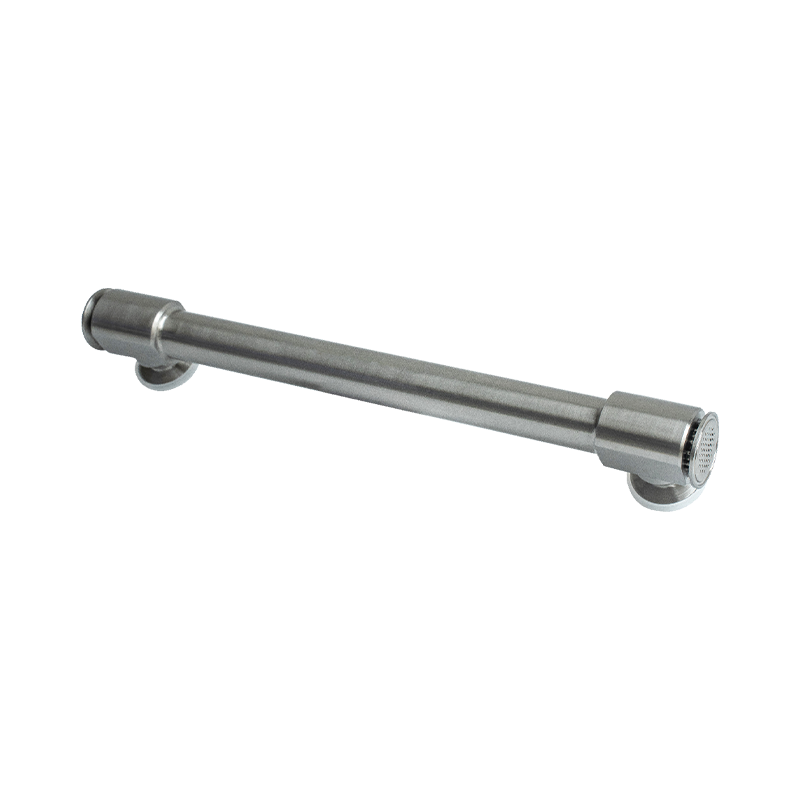 Custom Sanitary DTS (Double Tube Sheet) Heat Exchanger Manufacturers, FactoryShiloc (Shanghai) Industrial Trading Co., Ltd. Is China Custom Sanitary DTS (Double Tube Sheet) Heat Exchanger Manufacturers, Factory, 1....View Product →
What to Check Before You Specify a Skid
Start with the process parameters that define acceptable performance, then work backward to the hardware. Write every requirement in terms of the range it must hold, not just the setpoint at nominal conditions. The points below are the ones that separate a skid that performs from one that merely runs.
- Define acceptable control bands at production scale for temperature, pH, dissolved oxygen, and pressure, including transient phases such as inoculation and harvest.
- Verify turndown by testing flow, heating, and cooling performance at minimum and maximum load, not only at 100%.
- Require drainability and cleanability evidence, including dead-leg analysis and CIP velocity calculations.
- Confirm sensor and valve specifications, response times, and calibration procedures with batch-to-batch impact in mind.
- Audit the documentation package: material certificates, weld reports, surface finish measurements, and FAT records.
Supplier experience also shows up in performance. A skid is rarely a catalog product; it is the result of design choices made for a specific process. We have engineered and delivered integrated fluid process systems across biopharma and food applications, and that engineering and manufacturing experience directly shapes how we size heat exchangers, select pumps, and position sensors.
The pattern is consistent: skids that perform reliably are those whose process variables, thermal and hydraulic design, control architecture, and cleanability were considered together. No amount of control software compensates for undersized heat transfer or piping that cannot drain. If you can describe your process in the terms above, you are most of the way toward a skid that will not surprise you in production. To move from specification to implementation, discuss your process data with our engineering team.
PREV:Bioprocess Integrated Skids: Applications in Biologics & Vaccines
NEXT:How Material Selection Affects Bioprocess Skid Quality: A Buyer's Engineering Guide
NEXT:How Material Selection Affects Bioprocess Skid Quality: A Buyer's Engineering Guide
Interested in cooperation or have questions?
Recommended LINS
✦
Skid Mounted Process System
Process Skid System
Sanitary Process Skid
CIP Skid System for Food Industry
Food and Beverage Process System
food and beverage process skid system
Food Processing Skid System
automated process skid system for food processing
food ingredient mixing skid system
beverage blending skid system
Let'S Work Together Welcome Aboard!
-

haikexin@haikexin.com
+8613391278930
-
 +86-21-57560276
 -
 No. 2819, Sihu Road,Fengxian District, Shanghai, China
Join Our Mailing List
Copyright © Shiloc (Shanghai) Industrial Trading Co., Ltd. All Rights Reserved.
Process Systems & Equipment For Food & Biopharma Manufacturers
